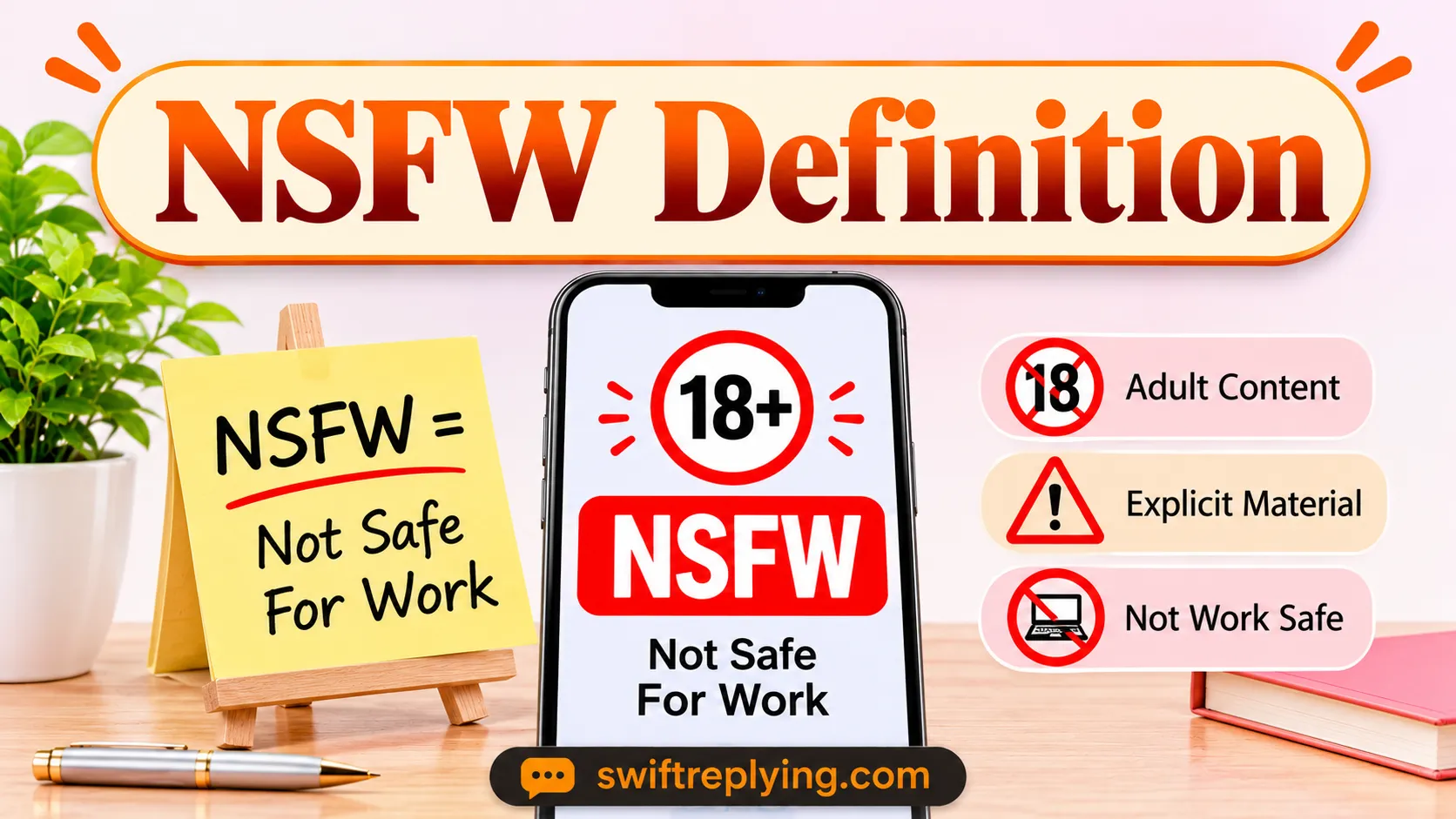
Have you ever opened a message, clicked a link, or scrolled through social media and noticed the label NSFW? If so, you might have wondered what it means and why people use it. This abbreviation appears frequently in text messages, emails, online discussions, websites, and social media posts.
NSFW stands for “Not Safe For Work.” People use it as a warning when content may be inappropriate to view in a professional, public, or shared setting. However, its meaning goes beyond workplace rules. It can also describe content that might be uncomfortable, embarrassing, or unsuitable for certain audiences.
Understanding the NSFW definition helps you recognize online warnings, communicate more clearly, and avoid opening potentially inappropriate material at the wrong time. Let’s explore what NSFW means, how people use it, and what to do when you encounter it.
Quick Answer: What Does NSFW Mean?
NSFW means “Not Safe For Work.” It is an internet abbreviation used to warn people that a message, image, video, website, or other online content may contain material unsuitable for viewing in a workplace or public setting.
NSFW content may include:
- Nudity or sexually suggestive material.
- Explicit language or adult humor.
- Graphic violence or disturbing images.
- Offensive jokes or inappropriate content.
- Other material that may cause embarrassment in public.
For example, someone might send you a message saying, “Don’t open that video at work. It’s NSFW.”
This means you should wait until you’re somewhere private before viewing it.
The opposite of NSFW is SFW, which means “Safe For Work.” It describes content generally suitable for viewing in professional or public environments.
What Does NSFW Stand For?
NSFW is an abbreviation of Not Safe For Work. It is commonly used across the internet to alert people that certain content may not be appropriate to view while working or sitting around other people.
The phrase doesn’t necessarily mean something is dangerous, illegal, or harmful. Instead, it suggests that the content could be embarrassing, offensive, distracting, or unsuitable for a professional environment.
For example, imagine you’re checking your email during a meeting. A coworker sends you a link with the subject line “NSFW.” That warning tells you to avoid opening the link until you’re somewhere private.
The abbreviation is useful because it communicates a warning without explaining the content in detail.
Breaking Down the NSFW Abbreviation
Here’s what each letter represents:
| Letter | Word | Meaning |
| N | Not | Something is unsuitable. |
| S | Safe | Appropriate or acceptable. |
| F | For | Intended for a particular setting. |
| W | Work | A professional or workplace environment. |
Together, these letters form Not Safe For Work.
Although the phrase mentions work, people also use it to describe content that shouldn’t be opened in schools, public transportation, family gatherings, or other shared spaces.
See Also: WTM Meaning in Text: What Does WTM Mean in Texting and Social Media?
What Does NSFW Mean in Texting?
In texting, NSFW is a warning that a message, picture, video, or link contains potentially inappropriate material.
Friends, coworkers, partners, and online acquaintances use it to give someone a heads-up before sharing adult jokes, suggestive pictures, offensive memes, or other sensitive material.
The meaning usually depends on the conversation and the relationship between the people involved.
Here are some examples of how NSFW appears in text messages:
Example 1:
- Person A: I found a hilarious video for you.
- Person B: Send it!
- Person A: Just a warning, it’s NSFW.
Meaning: The video may contain inappropriate material, so the recipient should watch it privately.
Example 2:
- Person A: Did you see the picture I sent?
- Person B: Not yet. What’s in it?
- Person A: It’s NSFW, so don’t open it around your family.
Meaning: The picture may contain adult or suggestive content.
Example 3:
- Person A: Check out this meme.
- Person B: I’m at the office right now.
- Person A: Oops! It’s NSFW. Save it for later.
Meaning: The sender realizes the content might not be suitable for a workplace.
In everyday texting, NSFW helps people avoid awkward situations. It also shows consideration for the other person’s surroundings.
What Does NSFW Mean on Social Media?
On social media, NSFW is a content warning that helps users recognize potentially inappropriate posts before viewing them.
You’ll often see it on platforms such as Reddit, X, Discord, and other online communities. People may add the abbreviation to captions, usernames, post titles, comments, or content tags.
For example:
- “NSFW meme ahead.”
- “This post contains NSFW pictures.”
- “Warning: NSFW discussion.”
- “Click only if you’re comfortable with adult humor.”
- “I’ve marked the video NSFW.”
Social media users apply the label to different types of content, including:
- Adult or sexually suggestive material.
- Nudity.
- Graphic images.
- Strong language.
- Offensive jokes.
- Disturbing videos.
However, NSFW doesn’t have one universal definition across every platform. Each website or community may have its own content rules and labeling system.
A post marked NSFW on one platform might not receive the same label somewhere else.
Why Do People Add NSFW Tags to Posts?
People use NSFW tags for several practical reasons.
Toward warn other users: The label helps people decide whether they want to view the content.
To avoid workplace embarrassment: Someone browsing social media during a break can recognize potentially inappropriate posts.
By respect personal boundaries: Not everyone feels comfortable viewing adult, violent, or offensive material.
To organize online content: Communities use content labels to help users identify posts that may need special attention.
Up to provide context: A warning lets readers know what to expect before opening a link or attachment.
An NSFW tag doesn’t automatically make content acceptable. Users still need to follow the platform’s rules and respect other people’s boundaries.
What Types of Content Are Considered NSFW?
NSFW is a broad label. It can apply to different kinds of material depending on the audience, environment, and context.
Here are the most common categories.
Adult and Sexual Content
Adult material is one of the most common reasons people use NSFW labels.
This category may include:
- Nudity.
- Sexually suggestive pictures.
- Explicit videos.
- Adult jokes.
- Sexual discussions.
- Pornographic material.
Such content is generally inappropriate to open in professional or shared environments.
Graphic Violence and Gore
Some people use NSFW to warn others about disturbing images or videos.
Examples include:
- Graphic injury photographs.
- Violent scenes.
- Images of serious accidents.
- Disturbing medical pictures.
- Graphic depictions of physical harm.
These materials may upset viewers, even when they don’t contain sexual content.
Offensive Language and Humor
NSFW can also describe jokes, memes, or conversations that contain inappropriate language.
Examples include:
- Strong profanity.
- Sexual jokes.
- Discriminatory humor.
- Offensive memes.
- Insulting or vulgar comments.
Whether something qualifies as NSFW depends on the audience and the setting.
A joke that friends find funny might be inappropriate in a workplace presentation.
See Also: 17 Other Ways to Say “All the Best” (With Examples)
Sensitive or Disturbing Material
Not every NSFW post contains adult content. Some posts involve subjects that people may prefer not to see unexpectedly.
These might include:
- Disturbing personal stories.
- Unpleasant medical imagery.
- Graphic crime-related material.
- Extremely upsetting photographs.
- Content involving sensitive subjects.
This is why it’s important to read the full warning rather than assuming every NSFW label refers to sexual material.
NSFW vs. SFW: What’s the Difference?
NSFW and SFW are opposite terms used to describe whether online content is generally appropriate for professional or public environments.
One more NSFW means Not Safe For Work, while SFW means Safe For Work.
Here’s a simple comparison:
| Feature | NSFW | SFW |
| Full form | Not Safe For Work | Safe For Work |
| Meaning | Potentially inappropriate content | Generally appropriate content |
| Common use | Adult material, graphic images, offensive jokes | Educational posts, ordinary pictures, professional content |
| Workplace suitability | May be unsuitable | Generally suitable |
| Purpose | Warns viewers | Indicates ordinary or appropriate content |
Examples of NSFW and SFW
Consider these situations:
NSFW example:
A friend sends you a meme containing an explicit joke and writes, “This is definitely NSFW.”
SFW example:
A coworker shares a motivational video and says, “This one is SFW. You can watch it during lunch.”
The main difference is the type of content and the environment where someone might view it.
Remember that SFW doesn’t guarantee that every person will find the material appropriate. It simply suggests that the content is generally suitable for ordinary public or professional viewing.
NSFW vs. NSFL: Are They the Same?
No. NSFW and NSFL are related internet abbreviations, but they communicate different warnings.
NSFL stands for “Not Safe For Life.” People use it to warn others about extremely disturbing or graphic content that may be emotionally upsetting.
NSFW is a broader label for material that may be inappropriate in a workplace or public environment. NSFL usually signals something much more disturbing.
| Term | Full Form | Main Purpose |
| NSFW | Not Safe For Work | Warns about potentially inappropriate content. |
| NSFL | Not Safe For Life | Warns about extremely disturbing content. |
| SFW | Safe For Work | Indicates generally appropriate content. |
When Is NSFL Used?
NSFL may appear alongside content involving:
- Extremely graphic violence.
- Severe injuries.
- Disturbing accident images.
- Graphic depictions of death.
- Highly upsetting material.
For example:
“Please don’t open this video. It’s NSFL.”
This warning suggests that the video contains extremely disturbing material and may be upsetting to watch.
The important distinction is that NSFW usually focuses on suitability, while NSFL emphasizes the potentially disturbing nature of the material.
Where Is NSFW Commonly Used?
NSFW appears across many online platforms and communication channels. Its purpose remains similar, but the way people use it can change depending on the platform.
NSFW on Reddit
On Reddit, NSFW is commonly used to label posts and communities containing adult or otherwise inappropriate material.
Users may encounter NSFW labels on:
- Post titles.
- Images.
- Videos.
- Community pages.
- Discussions.
The label helps users recognize potentially sensitive material before opening it.
Reddit also provides content settings that affect how certain posts appear. However, a label should not be treated as a complete description of everything a post contains.
NSFW on Discord
Discord users may use NSFW labels for channels or content that involve adult subjects.
For example, a server might have a channel marked NSFW to separate adult discussions from general conversations.
This helps communities establish boundaries and organize their content.
However, Discord’s content policies and age-related requirements still apply. An NSFW label does not give users permission to share prohibited material.
NSFW on X (Twitter)
On X, users may encounter NSFW warnings on posts containing adult or sensitive media.
People may include the abbreviation in captions or use the platform’s available sensitive-content settings.
For example:
“NSFW warning before you scroll.”
This tells followers that the upcoming post may contain material they don’t want to see unexpectedly.
NSFW in Emails
NSFW also appears in workplace and personal emails.
A sender might include the abbreviation in the subject line to warn recipients about an attachment or link.
Example:
Subject: NSFW Content Warning
Hi Alex,
I’ve included the video you requested. Please wait until you’re somewhere private before opening it because it contains adult humor.
Best,
Jordan
In professional communication, it’s usually better to explain the nature of the content when appropriate rather than relying on the abbreviation alone.
See Also: 200+ Best Responses to “You Don’t Love Me Anymore”
NSFW in Online Forums and Communities
Online forums use NSFW labels to help readers identify sensitive discussions.
These labels may appear on:
- Discussion threads.
- Shared photographs.
- Personal stories.
- Adult conversations.
- Graphic material.
They allow community members to make informed choices before viewing a post.
What Does NSFW Mean in a Workplace?
In a workplace, NSFW means that something may be inappropriate to view, share, or discuss in a professional environment.
It can refer to pictures, videos, websites, jokes, emails, or conversations that might make coworkers uncomfortable.
For example, imagine you’re working on your computer and a friend sends you an adult joke. Even if you find it funny, opening it in front of your manager or coworkers might create an awkward situation.
That’s why people use NSFW warnings.
Is NSFW Content Always Inappropriate at Work?
Not necessarily. The label is a warning, not a formal judgment about every workplace.
Different organizations have different standards regarding acceptable content. However, material involving explicit sexual content, graphic violence, harassment, or offensive language may violate workplace policies.
Before sharing something at work, consider:
- Your workplace rules: Does your organization allow this type of material?
- Your audience: Could someone feel uncomfortable seeing it?
- Your surroundings: Are other people able to see your screen?
- Your professional image: Could sharing the material affect how coworkers view you?
- Privacy: Does the content include someone else’s private information?
A simple rule is to avoid opening or sharing questionable material on workplace devices or in professional communication channels.
How Should You Respond When Someone Sends You NSFW Content?
Your response depends on your relationship with the sender and whether you’re comfortable receiving that type of content.
You don’t have to open, watch, or respond to anything that makes you uncomfortable.
Here are some natural replies you can use.
If You’re Curious
- “Okay, I’ll check it out when I’m somewhere private.”
- “Thanks for the warning. I’ll save it for later.”
- “Now you’ve made me curious!”
- “I’ll take a look when I have some privacy.”
- “What’s the general idea behind it?”
If You’re at Work
- “I’m at work right now. I’ll check it later.”
- “Thanks for the heads-up. Not opening that here!”
- “I’ll save that for when I get home.”
- “Let’s discuss it after work.”
- “I’ll pass for now. I’m in the office.”
If You’re Not Comfortable
- “I’d rather not receive that kind of content.”
- “Thanks, but that’s not really my thing.”
- “Please don’t send me anything like that again.”
- “I’m not comfortable viewing that material.”
- “Let’s keep our conversations appropriate.”
If You Want to Keep Things Light
- “Good thing you warned me!”
- “My workplace laptop thanks you.”
- “I’ll risk my curiosity later.”
- “Not opening that in public!”
- “That sounds like a private-time activity.”
The most important thing is to communicate your comfort level clearly. You don’t need to explain or defend your decision.
How to Know Whether Something Is NSFW
Sometimes, people share links or attachments without explaining exactly what’s inside. In these situations, recognizing warning signs can help you avoid unexpected content.
Look for the following clues:
1. An NSFW label: The sender or platform may clearly mark the content as inappropriate for public viewing.
2. A warning in the caption: Phrases such as “adult content,” “explicit material,” or “viewer discretion advised” may indicate sensitive content.
3. The source or community: Some online communities focus on adult discussions or graphic material.
4. The conversation context: If someone says, “Don’t open this around your parents,” they may be suggesting that the content isn’t suitable for a shared setting.
5. Content warnings: Platforms may display warnings before showing sensitive images or videos.
If you’re unsure, don’t open the content in a public place. You can ask the sender what type of material it contains.
See Also: 200+ Best Responses to “Nice to Meet You”
What Should You Do If You Accidentally Open NSFW Content at Work?
Accidentally opening inappropriate content can happen to anyone. A friend might send an unexpected video, or an online link might contain something you weren’t expecting.
The best response is to stay calm and handle the situation professionally.
Here are some practical steps:
- Close the content: If something inappropriate appears, close the page or application.
- Avoid sharing it: Don’t forward the material to coworkers or other people.
- Check your surroundings: Make sure the content isn’t still visible on your screen.
- Follow workplace policies: If the material violates company rules or involves harassment, follow the appropriate reporting process.
- Adjust your settings: Use available content filters or warning settings to reduce unexpected exposure.
- Ask people to respect your boundaries: If someone repeatedly sends inappropriate content, tell them to stop.
An accidental click doesn’t automatically mean you’ve done something wrong. What matters is how you respond and whether you follow your organization’s policies.
Is NSFW the Same as Adult Content?
No. Although NSFW often refers to adult material, the two terms don’t mean exactly the same thing.
Adult content generally refers to material intended for mature audiences, such as sexually explicit pictures, videos, or discussions.
NSFW describes content that may be unsuitable for a workplace or public setting.
For example, a graphic accident photograph might be labeled NSFW even though it has nothing to do with adult entertainment.
Likewise, a harmless educational discussion about a sensitive subject might be suitable for a professional environment, depending on its presentation and context.
Here’s a simple comparison:
| NSFW | Adult Content |
| A warning about potentially inappropriate material | Material intended for mature audiences |
| Can include violence, nudity, or offensive language | Usually involves mature or sexual subjects |
| Depends on the viewing environment | Depends on the nature and intended audience of the material |
| May include nonsexual content | Does not necessarily mean unsuitable for every professional discussion |
Therefore, NSFW is a broader term than adult content.
Is NSFW a Bad Word?
No. NSFW isn’t a swear word or an offensive expression. It’s a common internet abbreviation used to communicate a content warning.
People use it in casual conversations, online communities, workplace messages, and social media posts.
However, the material described as NSFW may contain offensive or explicit content.
For example:
- “This meme is NSFW.”
- “I found an NSFW website.”
- “Please add an NSFW warning to the post.”
- “That video probably shouldn’t be opened at work.”
None of these sentences uses an inappropriate word. They’re simply warning someone about the content.
Can You Use NSFW in Professional Communication?
Yes, but you should consider your audience and workplace culture.
NSFW is widely recognized in online communication, especially among people who regularly use social media and internet slang.
However, not everyone understands the abbreviation. In formal business communication, a clearer description may be more appropriate.
For example:
Casual workplace message:
“There’s an NSFW meme in the group chat. Don’t open it during the meeting.”
More professional message:
“The attachment contains sensitive material. Please review it privately.”
Another professional example:
“Please be aware that the video contains graphic imagery before viewing.”
When communicating with clients, managers, or people outside your organization, clear descriptions are usually better than unexplained internet abbreviations.
Other Common Internet Abbreviations Related to NSFW
NSFW is part of a larger collection of internet abbreviations used in texting and online conversations.
Understanding these related terms can help you recognize different types of content warnings.
| Abbreviation | Full Form | Meaning |
| SFW | Safe For Work | Content generally suitable for public or professional settings. |
| NSFL | Not Safe For Life | Warning about extremely disturbing content. |
| TMI | Too Much Information | Someone has shared more personal detail than necessary. |
| TW | Trigger Warning | A warning about potentially upsetting subjects. |
| CW | Content Warning | Alerts readers to sensitive material. |
| NFSW | Not For Safe Work (often a typo) | Usually an incorrect version of NSFW. |
| PFP | Profile Picture | An image used to represent an account. |
| IRL | In Real Life | Refers to something outside the internet. |
| DM | Direct Message | A private message sent through a platform. |
| AFK | Away From Keyboard | Indicates that someone is temporarily unavailable. |
NSFW vs. TW vs. CW
These three abbreviations can appear on similar posts, but they serve different purposes.
- NSFW: Warns that content may be inappropriate for work or public viewing.
- TW: Alerts readers to material that could be emotionally triggering.
- CW: Provides general information about sensitive subjects included in content.
For example, a post discussing a traumatic experience might have a trigger warning even if it contains no adult pictures or offensive language.
Likewise, an NSFW post might contain an explicit joke without involving a subject that requires a trigger warning.
These labels aren’t interchangeable, although one post may use more than one.
See Also: KM Meaning in Text: What Does KM Mean in Chat?
Does NSFW Mean the Same Thing Everywhere?
Not always. The general definition remains “Not Safe For Work,” but people and platforms may apply the label differently.
For example, one person might use NSFW only for explicit sexual material. Another might use it for violent videos, strong language, or offensive jokes.
A platform may also have specific rules about what content needs a warning.
Consider these differences:
- Personal conversations: Friends may use NSFW casually to warn each other about inappropriate jokes or pictures.
- Workplace communication: Employees may use it to identify material that shouldn’t be opened around coworkers.
- Social media: Creators may use NSFW labels to identify sensitive or adult-oriented posts.
- Online communities: Moderators may apply NSFW tags according to community rules.
Therefore, don’t assume every NSFW label describes the same kind of material. Read the surrounding warning and consider the context.
FAQs About NSFW Definition
What does NSFW mean in simple words?
NSFW means “Not Safe For Work.” It’s a warning that online content may be inappropriate to view in a workplace or public setting.
What does NSFW mean from a guy or girl?
The meaning doesn’t change based on gender. If someone sends you NSFW content, they’re generally warning you that it may contain adult, suggestive, graphic, or otherwise inappropriate material.
What is the opposite of NSFW?
The opposite of NSFW is SFW, which stands for “Safe For Work.” It describes content generally suitable for professional or public environments.
Conclusion
Understanding the NSFW definition makes online communication easier and helps you recognize potentially inappropriate content. NSFW stands for “Not Safe For Work” and is commonly used in text messages, emails, social media posts, and online communities to warn people before they open sensitive material.
Remember that NSFW doesn’t always mean something sexual. It can also describe graphic images, offensive jokes, strong language, or disturbing videos. When you see this abbreviation, consider your surroundings before opening the content. If you’re unsure, it’s always better to wait until you’re somewhere private.

Naeem Raza is a passionate writer with multiple years of experience in the responses niche. He enjoys exploring effective ways to communicate, helping readers find thoughtful, natural, and appropriate responses for everyday conversations and different social situations. Through his work at swiftreplying.com, Naeem aims to make communication easier, more confident, and more meaningful. Stay connected and explore more helpful insights and practical response ideas through his latest articles.








2 thoughts on “NSFW Definition: What Does NSFW Mean in Texting, Social Media, and Online?”