Have you ever received a text that simply says “SMH” and wondered what the sender was trying to express? This short abbreviation appears in text messages, social media comments, and online conversations. Although it contains only three letters, it can communicate disappointment, frustration, disbelief, or mild annoyance.
Understanding SMH meaning in text messaging can help you follow conversations and respond naturally. Whether a friend uses it after hearing surprising news or someone adds it to a social media comment, its meaning usually becomes clear when you consider the situation.
Quick Answer: What Does SMH Mean in Text Messaging?
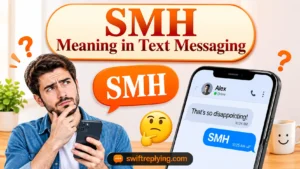
SMH stands for “shaking my head.” People use it in text messages and online conversations to express disappointment, disbelief, frustration, embarrassment, or disapproval.
For example:
Friend: “I forgot my phone at home again.”
You: “SMH 😂”
Here, SMH suggests that you’re shaking your head because your friend made another silly mistake.
The abbreviation doesn’t always express anger. Depending on the conversation, it can sound playful, sarcastic, disappointed, or genuinely frustrated.
What Does SMH Stand For?
SMH stands for shaking my head. It’s an internet abbreviation that describes the gesture of moving your head from side to side or shaking it in response to something.
People often shake their heads when they hear something disappointing, unbelievable, frustrating, or foolish. In digital conversations, SMH communicates that reaction without requiring a long explanation.
For example:
- Your friend makes the same mistake again: “SMH, you never learn!”
- Someone shares unbelievable news: “SMH, I can’t believe this happened.”
- Your brother forgets an important appointment: “SMH 😂”
- Someone behaves rudely: “That was unnecessary. SMH.”
In each example, the abbreviation communicates a reaction rather than a complete sentence.
What Does SMH Mean in a Text Message?
In a text message, SMH usually shows how someone feels about something that has happened or been said.
Its exact tone depends on the conversation, the relationship between the people, and the situation.
Here are the most common feelings it can express.
Disappointment
Someone might use SMH when another person makes a poor decision or fails to meet expectations.
Example:
Person A: “He canceled our plans at the last minute again.”
Person B: “SMH. That’s really disappointing.”
The abbreviation shows that the sender disapproves of the situation.
Disbelief
SMH can communicate surprise when something seems difficult to believe.
Example:
Person A: “Someone paid $500 for a broken phone.”
Person B: “SMH, people really do anything.”
Here, the sender is expressing disbelief about the purchase.
Frustration
People also use SMH when something annoying happens repeatedly.
Example:
Person A: “My internet stopped working during the meeting.”
Person B: “SMH, that’s so frustrating.”
The abbreviation adds an emotional reaction to the message.
Embarrassment
Sometimes SMH expresses embarrassment about your own actions or someone else’s behavior.
Example:
Person A: “I waved at someone who wasn’t waving at me.”
Person B: “SMH 😂 That must have been awkward.”
The laughing emoji makes the reaction playful rather than harsh.
Disapproval
When someone does something inappropriate or inconsiderate, SMH can show that the sender doesn’t approve.
Example:
Person A: “He made fun of someone in front of everyone.”
Person B: “SMH. That’s not okay.”
In this situation, SMH communicates disappointment and disapproval.
How to Use SMH in Texting
You can use SMH in casual conversations with friends, family members, and people who understand internet slang. It works best when you want to express a quick reaction without explaining everything.
Here are some natural ways to use it.
Use SMH at the Beginning of a Message
Placing SMH at the beginning makes your reaction clear before you explain your thoughts.
Examples:
- “SMH, why would he do that?”
- “SMH, you forgot your keys again.”
- “SMH, this weather is unbelievable.”
- “SMH, I can’t believe you said that.”
- “SMH, some people never change.”
Use SMH at the End of a Message
You can also place it at the end to emphasize your reaction.
Examples:
- “He missed the bus again, SMH.”
- “You really ate the whole pizza, SMH 😂”
- “That was such a bad decision, SMH.”
- “I can’t believe this happened, SMH.”
- “People can be so careless, SMH.”
Use SMH as a Complete Reply
Sometimes you don’t need to write a full sentence. SMH can work as a short response when the situation is already clear.
Examples:
Friend: “I locked myself out of my apartment.”
You: “SMH 😂”
Friend: “He forgot his own birthday.”
You: “SMH!”
Friend: “My laptop crashed right before I saved my work.”
You: “SMH. That’s terrible.”
The context helps the other person understand your reaction.
See Also: DI Meaning in Text Messages: What Does DI Mean in a Chat?
Examples of SMH in Different Conversations
The meaning of SMH can change slightly depending on the situation. These examples show how people might use it in everyday conversations.
SMH in Conversations With Friends
Friends often use SMH to tease each other or react to silly situations.
- “SMH, you really forgot my birthday?”
- “You bought another pair of shoes? SMH 😂”
- “SMH, we just talked about this yesterday.”
- “You missed the easiest question. SMH!”
- “SMH, you’re always doing something funny.”
In friendly conversations, it often sounds humorous rather than serious.
SMH in Family Conversations
Family members may use SMH when reacting to everyday mistakes or unexpected behavior.
- “SMH, your room is still a mess.”
- “You left the lights on again, SMH.”
- “SMH, why didn’t you tell me earlier?”
- “You forgot to bring the groceries? SMH.”
- “SMH, we need to start making a shopping list.”
The tone depends on how the family members normally communicate.
SMH in Romantic Conversations
In romantic relationships, SMH can express playful annoyance, disappointment, or disbelief.
- “SMH, you stole my fries again 😂”
- “You really forgot our movie night? SMH.”
- “SMH, you’re impossible sometimes.”
- “I can’t believe you fell asleep during our call, SMH.”
- “SMH, but I still love you.”
When used affectionately, it can make a conversation feel lighthearted. However, it can sound critical if the situation is already tense.
SMH in Social Media Comments
SMH is also common in online discussions and comment sections. People use it to react to posts, videos, opinions, and news.
Examples:
- “SMH, this is getting ridiculous.”
- “People really need to think before posting. SMH.”
- “SMH, what did I just watch?”
- “I can’t believe someone actually did that. SMH.”
- “SMH, this could have been avoided.”
On social media, it can express anything from mild amusement to strong disapproval.
See Also: 200+ Best Responses to “What Are You Up To Tonight?”
SMH in Group Chats
Group chats often include quick reactions, especially when several people are discussing the same event.
Examples:
- “SMH, nobody remembered the meeting time.”
- “We all agreed on 7 PM. SMH.”
- “SMH, now we’re waiting for everyone again.”
- “That plan went wrong so quickly 😂”
- “SMH, this group is never organized.”
Because everyone shares the conversation’s context, a short SMH response can be enough.
What Does SMH Mean With Different Emojis?
Adding an emoji can change the tone of SMH. The abbreviation still means “shaking my head,” but the emoji gives readers more clues about the sender’s feelings.
| Text | Possible meaning |
| SMH 😂 | Playful disbelief or amusement |
| SMH 🙄 | Annoyance or frustration |
| SMH 😭 | Dramatic disappointment or disbelief |
| SMH 🤦 | Frustration or embarrassment |
| SMH 💀 | Something is unbelievably funny or ridiculous |
| SMH 😔 | Sadness or disappointment |
| SMH 😒 | Disapproval or irritation |
| SMH 🤣 | Finding a situation ridiculous or funny |
SMH 😂
This combination usually makes the message feel playful.
Example: “SMH 😂 You really forgot your own password?”
The sender is probably teasing rather than criticizing.
SMH 🙄
The eye-roll emoji makes the reaction sound more annoyed or sarcastic.
Example: “SMH 🙄 He did the same thing again.”
It suggests that the sender is tired of repeated behavior.
SMH 😭
This combination can express dramatic frustration, disbelief, or amusement.
Example: “SMH 😭 I studied the wrong chapter for the test.”
The crying emoji adds emotion and can make the situation sound funny or upsetting.
SMH 🤦
This combination emphasizes embarrassment or frustration.
Example: “SMH 🤦 I sent the message to the wrong person.”
It suggests that the sender can’t believe they made that mistake.
Is SMH Rude or Disrespectful?
SMH isn’t automatically rude, but it can sound disrespectful depending on how you use it.
Among close friends, it may be a harmless way to tease someone. In a serious conversation, however, it can make the other person feel judged or dismissed.
Consider these examples:
Friendly use:
“SMH 😂 You ate the last slice without asking!”
This sounds playful if both people are comfortable teasing each other.
Potentially disrespectful use:
“SMH. You never understand anything.”
This sounds insulting because it criticizes the other person rather than simply reacting to a situation.
Professional use:
“SMH, this report is completely wrong.”
This is generally inappropriate in a workplace conversation because it can sound unprofessional and disrespectful.
If you want to avoid misunderstandings, consider the relationship and the topic before using SMH.
See Also: 11 Different Ways to Say ‘Please See Attached’ in Email (With Examples)
What Is the Difference Between SMH and Other Texting Abbreviations?
SMH is one of many abbreviations people use in digital conversations. However, it doesn’t communicate the same feeling as every other slang term.
Here’s how it compares with some common texting abbreviations.
| Abbreviation | Full form | Common meaning |
| SMH | Shaking my head | Disbelief, disappointment, or frustration |
| LOL | Laughing out loud | Amusement or laughter |
| OMG | Oh my God | Surprise, excitement, or disbelief |
| IDK | I don’t know | Uncertainty or lack of knowledge |
| TBH | To be honest | Introducing an honest opinion |
| IMO | In my opinion | Sharing a personal viewpoint |
| FR | For real | Agreement or emphasis |
| WTH | What the heck | Surprise, confusion, or frustration |
| NGL | Not gonna lie | Introducing a candid statement |
SMH vs. LOL
SMH usually communicates disappointment, disbelief, or frustration. LOL generally communicates laughter or amusement.
SMH: “You forgot your wallet again. SMH.”
LOL: “You forgot your wallet again? LOL!”
The first expresses disbelief or mild frustration. The second sounds more amused.
SMH vs. OMG
OMG expresses surprise, excitement, or shock. SMH usually communicates a reaction involving disappointment or disbelief.
OMG: “OMG, I won the competition!”
SMH: “SMH, I can’t believe he missed the final question.”
SMH vs. IDK
IDK means “I don’t know.” It expresses uncertainty rather than a reaction of disappointment.
IDK: “IDK what happened.”
SMH: “SMH, I can’t believe what happened.”
These abbreviations serve different purposes, even though they can appear in the same conversation.
How Should You Respond When Someone Texts SMH?
Your response should match the sender’s tone and the situation. If they’re joking, you can reply playfully. If they’re disappointed, a more thoughtful response may work better.
Here are some possible replies.
Funny Responses
Use these when someone sends SMH in a playful conversation.
- “Don’t judge me!”
- “I’m doing my best 😂”
- “It happens to the best of us.”
- “You know how I am!”
- “At least I’m consistent.”
Playful Responses
These work well when you’re teasing someone you know.
- “Here you go shaking your head again.”
- “I know, I’m a little dramatic.”
- “You can’t handle my genius.”
- “Stop judging me!”
- “What can I say? I’m unpredictable.”
Apologetic Responses
If someone uses SMH because you’ve made a mistake, acknowledge the situation.
- “I know, that was my mistake.”
- “Sorry, I’ll be more careful next time.”
- “You’re right. I should have checked.”
- “I didn’t mean for that to happen.”
- “I’ll make sure it doesn’t happen again.”
Calm Responses
If the message feels critical, you can respond without making the situation worse.
- “Is something bothering you?”
- “Can you explain what you mean?”
- “I understand why you’re frustrated.”
- “Let’s talk about what happened.”
- “I didn’t mean to upset you.”
The best reply depends on whether the sender is joking, expressing frustration, or criticizing something you did.
See Also: 200+ Best Responses to “Okay”
Is SMH Still Used in Text Messages?
Yes. SMH remains a recognizable internet and texting abbreviation. People use it in casual messages, social media comments, online discussions, and group chats.
Its usefulness comes from how quickly it communicates a familiar reaction. Instead of writing, “I can’t believe you did that,” someone can simply type “SMH.”
However, not everyone uses texting abbreviations in the same way. Some people use SMH regularly, while others prefer complete sentences or emojis.
You may also see it written in different forms:
- SMH: The standard uppercase form.
- smh: A casual lowercase version.
- Smh: A capitalized version sometimes used at the beginning of a sentence.
All three generally communicate the same idea.
Can SMH Have Different Meanings?
Although shaking my head is the widely recognized meaning of SMH in internet slang, abbreviations can have other meanings in specific settings.
For example, DI, IT, education, business, and other professional fields may use the same letters for their own terms. In those situations, the meaning depends on the subject being discussed.
However, when you see SMH in an ordinary text message, social media comment, or casual online conversation, shaking my head is the most likely interpretation.
It’s also important to remember that people sometimes use abbreviations privately. A friend may give SMH a personal meaning within a particular conversation, even if that isn’t the usual internet meaning.
If the abbreviation appears in an unclear message, look at the surrounding words before deciding what the sender means.
When Should You Avoid Using SMH?
SMH works well in casual conversations, but it isn’t suitable for every situation.
You may want to avoid it in the following cases:
- Professional emails: It can make your message seem careless or disrespectful.
- Serious disagreements: The abbreviation may sound dismissive when someone wants to be heard.
- Sensitive conversations: A person discussing a difficult experience may interpret it as criticism.
- Formal communication: Complete sentences are usually clearer and more appropriate.
- Messages to unfamiliar people: They may not understand the abbreviation or its intended tone.
Instead of writing “SMH” in a serious conversation, explain your reaction clearly.
For example, rather than saying:
“SMH, that’s disappointing.”
You could write:
“I’m disappointed that this happened. Can we talk about it?”
The second message communicates your feelings more directly and respectfully.
FAQs About SMH Meaning in Text Messaging
What does SMH mean in texting?
SMH means shaking my head. People use it to express disbelief, disappointment, frustration, embarrassment, or disapproval in digital conversations.
What does SMH mean from a girl or a guy?
The meaning doesn’t change based on gender. A girl or guy can use SMH to show amusement, frustration, disbelief, or disappointment. The surrounding conversation helps you understand the intended tone.
Does SMH mean shaking my head?
Yes. In common internet slang, SMH stands for shaking my head. It describes the reaction someone might have when something seems disappointing, frustrating, or unbelievable.
Conclusion
SMH means “shaking my head” in text messaging. It’s a quick way to express disbelief, disappointment, frustration, embarrassment, or playful annoyance. You can use it in casual conversations with friends, family, and people who understand internet slang. Just remember that its tone depends on the situation. When you understand the context, it’s much easier to recognize what someone means and choose a natural response.

Muhammad Haroon brings multiple years of experience in creating clear, thoughtful, and engaging responses for everyday communication. As a contributor to SwiftReplying.com, he enjoys helping readers discover the right words for different conversations, situations, and social interactions. With a passion for language and effective communication, he makes expressing ideas easier and more natural. Explore more of his helpful content on SwiftReplying.com and make every response count.