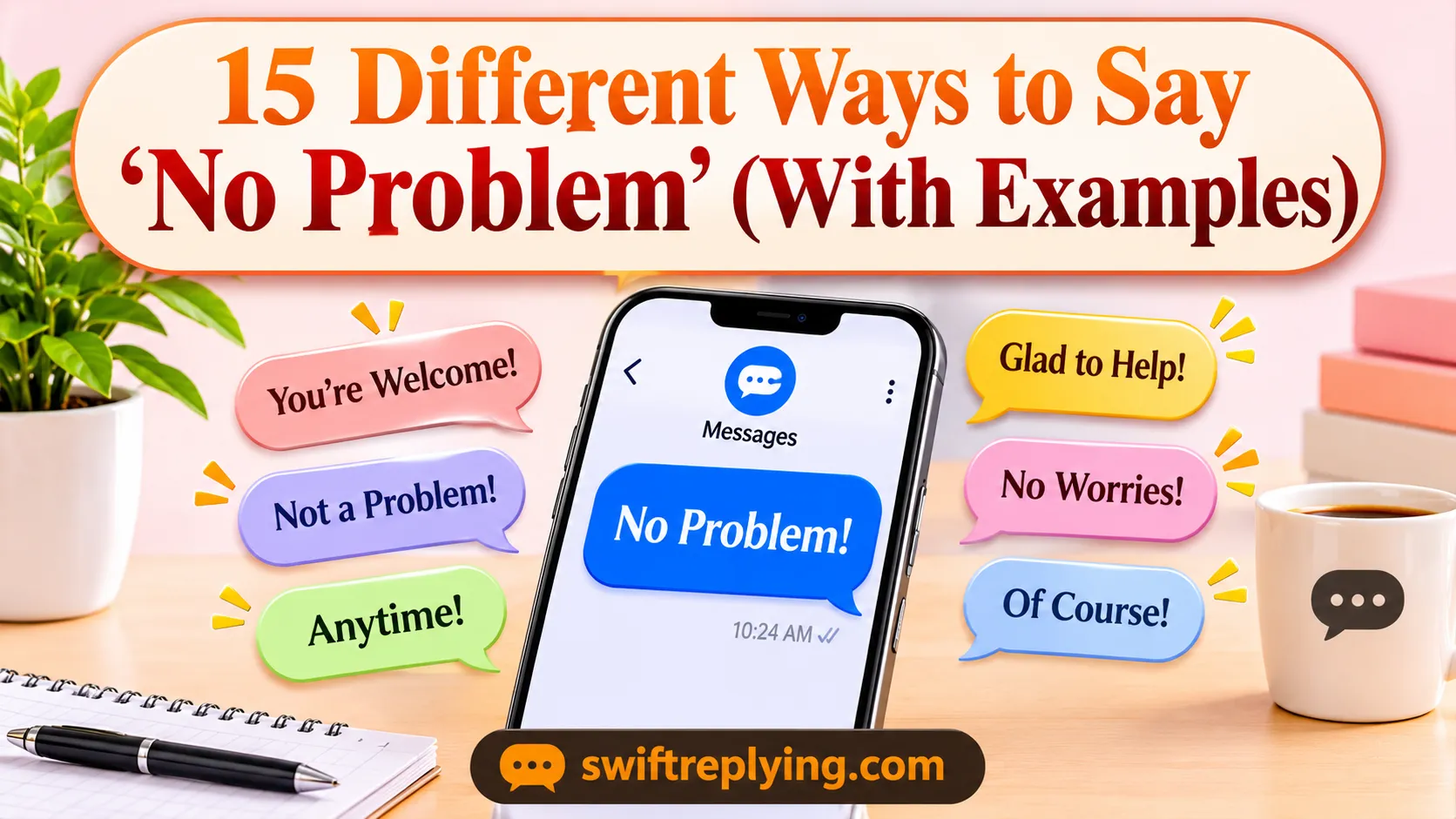
Sometimes, saying “No problem” is the easiest way to respond when someone thanks you, asks for help, or apologizes. It is friendly and natural, but using the same expression repeatedly can make conversations sound a little predictable. Exploring different ways to say “No problem” can help you communicate with more warmth, confidence, and variety.
Whether you are replying to a friend, reassuring a family member, responding to a colleague, or writing a professional email, the right alternative can make your message feel more appropriate. In this article, we will explore 15 natural alternatives to “No Problem,” explain what each expression means, and provide practical examples to help you choose the right words for different situations.
15 Other Ways to Say “No Problem”
- You’re Welcome
- Of Course
- Happy to Help
- No Worries
- My Pleasure
- Anytime
- Not at All
- Don’t Mention It
- Glad to Help
- Sure Thing
- Absolutely
- It’s All Good
- No Trouble at All
- Think Nothing of It
- Glad I Could Help
What Does “No Problem” Mean?
The expression “No Problem” means that something is not difficult, inconvenient, or troublesome for you. It is commonly used to reassure someone that their request, apology, or favor has not caused any inconvenience.
For example, when someone says, “Thank you for helping me,” responding with “No problem” communicates that you were happy to help and did not find the task difficult.
The expression can also make someone feel comfortable after they apologize.
For example:
- Person A: “Sorry for bothering you.”
- Person B: “No problem!”
In this situation, the phrase suggests that the other person’s request or interruption was perfectly acceptable.
Although its basic meaning is straightforward, “No Problem” can communicate different feelings depending on the situation. It can sound casual, friendly, reassuring, or occasionally a little dismissive if delivered without warmth.
When to Use “No Problem”
“No Problem” is a versatile expression that works in many everyday situations.
Here are some common examples:
- With friends: When someone thanks you for doing a small favor.
- With family: When a family member asks you to help with something.
- With your partner: When you want to reassure them that something they requested was not inconvenient.
- At work: When a colleague thanks you for completing a task.
- In emails: When responding to a simple request or acknowledging a small inconvenience.
- In texting: When you want to give a quick, relaxed response.
- In customer service: When reassuring a customer that their request is manageable.
However, the expression may not always communicate the level of appreciation or professionalism you intend.
For example, “My Pleasure” may sound warmer when responding to a customer, while “Certainly” may be more appropriate when acknowledging a formal workplace request.
Choosing another expression can help your response match the relationship and situation.
Is It Professional or Polite to Say “No Problem”?
Yes. “No Problem” is generally polite and acceptable in professional communication, especially when speaking with colleagues or responding to straightforward requests.
However, it is relatively informal. Its suitability depends on your workplace culture, the person you are addressing, and the nature of the conversation.
Consider these examples:
- Casual workplace: “No problem! I’ll send you the document shortly.”
- Professional email: “Of course. I’ll send you the document shortly.”
- Customer communication: “My pleasure. Please let me know if you need anything else.”
- Formal conversation: “Certainly. I’d be happy to assist.”
When speaking with friends, family, or familiar colleagues, “No Problem” sounds natural. In formal emails or customer-facing situations, alternatives such as “Certainly,” “My Pleasure,” and “Happy to Help” can create a warmer or more polished impression.
The important thing is to choose wording that feels respectful without sounding unnecessarily formal.
See Also: IGH Meaning in Gaming: What Does IGH Mean in Online Games and Chat?
1. You’re Welcome
“You’re Welcome” is one of the most natural alternatives to “No Problem,” particularly when someone expresses gratitude. Both expressions acknowledge appreciation, but they communicate slightly different things. “No Problem” suggests that helping was not an inconvenience, while “You’re Welcome” directly responds to the person’s thanks.
This expression works well in everyday conversations, professional interactions, and written messages. It is also a safe choice when you are unsure how formal your response should be. Unlike some casual alternatives, it does not depend heavily on familiarity.
Scenario
Someone thanks you for helping them prepare a presentation. Instead of saying “No Problem,” you respond with “You’re Welcome” to acknowledge their appreciation politely.
Examples
- “You’re welcome! I’m glad I could help.”
- “You’re welcome. Let me know if you need anything else.”
- “You’re welcome! I hope the presentation goes well.”
- “You’re very welcome. It was nice working with you.”
- “You’re welcome, and thank you for saying that.”
Tone
Polite, friendly, respectful, and neutral. It sounds natural in both personal and professional conversations.
Explanation
This expression works because it directly acknowledges someone’s gratitude. It is not exactly identical to “No Problem,” since it focuses on receiving thanks rather than dismissing inconvenience. However, it serves the same conversational purpose when someone appreciates your help.
Best Use
Friendly conversations, workplace interactions, customer service, emails, and situations where someone has thanked you.
2. Of Course
“Of Course” is a warm and confident alternative when someone asks you for help or thanks you for doing something. It suggests that helping them was an obvious or perfectly reasonable thing to do.
Unlike “No Problem,” this expression communicates willingness rather than simply saying that something was not difficult. It is particularly useful when you want someone to feel comfortable asking you for assistance.
For example, if a colleague asks you to review a document, saying “Of Course” makes your response sound cooperative and positive.
Scenario
A coworker asks whether you can explain a difficult part of a report. You want to show that you are willing to help without making the request feel like a burden.
Examples
- “Of course! I’d be happy to explain it.”
- “Of course, you can borrow my notes.”
- “Of course. I’ll take a look at the document.”
- “Of course! Just let me know when you need me.”
- “Of course, I’m happy to help you with that.”
Tone
Friendly, reassuring, confident, and polite.
Explanation
“Of Course” works as an alternative because it communicates that the request is acceptable and that you are willing to cooperate. It can make the other person feel comfortable rather than guilty for asking.
However, it is more appropriate as a response to a request than as a direct replacement after every expression of thanks.
Best Use
Workplace conversations, requests for assistance, family discussions, and friendly interactions where you want to express willingness.
3. Happy to Help
“Happy to Help” is an excellent alternative when you want to communicate genuine willingness and a positive attitude. It goes beyond simply saying that something was not a problem. Instead, it tells the other person that you were pleased to provide assistance.
This expression is especially useful in professional communication because it sounds friendly without becoming overly casual. It also works well when responding to customers, colleagues, clients, or someone who has thanked you for your support.
Scenario
A customer thanks you for explaining how to use a service. You want to acknowledge their appreciation while showing that you were glad to assist.
Examples
- “Happy to help! Please reach out if you have any other questions.”
- “I’m happy to help you understand the process.”
- “Happy to help. I’ll send you the updated information.”
- “I’m always happy to help when you need assistance.”
- “Happy to help! I hope everything works out.”
Tone
Warm, professional, supportive, and approachable.
Explanation
This phrase is effective because it communicates a positive attitude toward helping someone. While “No Problem” focuses on the absence of inconvenience, “Happy to Help” emphasizes your willingness and positive feelings.
It is a particularly good choice when you want your response to sound more thoughtful and service-oriented.
Best Use
Professional emails, customer service, workplace conversations, collaborative projects, and supportive messages.
4. No Worries
“No Worries” is a relaxed and friendly alternative to “No Problem.” It is especially useful when someone apologizes, expresses concern, or worries that they have inconvenienced you.
The phrase reassures the other person that everything is fine. It can also make everyday conversations feel more comfortable and less serious.
Unlike “Happy to Help,” which emphasizes willingness, “No Worries” focuses on removing concern or guilt. It is informal, so it is generally better suited to familiar conversations than highly formal correspondence.
Scenario
A friend apologizes for arriving a few minutes late to meet you. You want to let them know that you are not upset and that there is no need to apologize.
Examples
- “No worries! Take your time.”
- “No worries, I can wait a few more minutes.”
- “No worries about the delay. We can reschedule.”
- “No worries! It happens to everyone.”
- “No worries, there’s nothing to apologize for.”
Tone
Casual, friendly, reassuring, and relaxed.
Explanation
“No Worries” works because it directly addresses someone’s concern. It communicates that the situation is acceptable and that they do not need to feel uncomfortable.
It is particularly effective after an apology. However, it may sound too casual in a formal business letter or a serious professional discussion.
Best Use
Text messages, conversations with friends, family discussions, minor apologies, and informal workplace communication.
See Also: Text Structure in Literature and Nonfiction: Meaning, Types, Examples
5. My Pleasure
“My Pleasure” is a polished and considerate alternative that communicates genuine enjoyment in helping someone. It is often used when someone expresses gratitude for assistance, especially when you want your response to sound warm and respectful.
Compared with “No Problem,” this expression places more emphasis on your positive attitude. It suggests that helping was not merely convenient but something you were pleased to do.
It is especially appropriate in customer service, hospitality, and professional environments where a courteous impression matters.
Scenario
A client thanks you for taking extra time to explain a service. You want to acknowledge their gratitude in a professional but welcoming way.
Examples
- “My pleasure! I’m glad everything is sorted out.”
- “It was my pleasure to assist you today.”
- “My pleasure. Please let me know if you need further assistance.”
- “It was truly my pleasure working with your team.”
- “My pleasure! I hope you enjoy the results.”
Tone
Polite, warm, professional, and considerate.
Explanation
“My Pleasure” works because it changes the focus from the absence of difficulty to the enjoyment of helping. It can make the other person feel appreciated and welcomed.
It is more polished than “No Problem,” although it may sound slightly formal in a casual conversation with close friends.
Best Use
Customer service, professional emails, hospitality, client communication, and situations where you want to show genuine appreciation.
6. Anytime
“Anytime” is a simple, friendly alternative that communicates your willingness to help again in the future. It is especially suitable when someone thanks you for a favor or assistance.
Unlike “No Problem,” which addresses the current situation, “Anytime” suggests that the person can approach you again if they need help.
However, it should be used thoughtfully. Saying “Anytime” can imply that you are generally available to assist, so it is best when you genuinely mean it.
Scenario
Your friend thanks you for helping them move some furniture. You want to let them know that they can ask you for help again.
Examples
- “Anytime! Just let me know when you need help.”
- “You’re welcome. Anytime you need a hand.”
- “Anytime! I’m glad I could make things easier.”
- “Of course, anytime. That’s what friends are for.”
- “Anytime! Don’t hesitate to reach out.”
Tone
Friendly, generous, supportive, and casual.
Explanation
“Anytime” works because it communicates openness to future requests. It is a little more personal than “No Problem” because it suggests an ongoing willingness to help.
It is not always appropriate when you cannot realistically offer help again, particularly in professional settings where availability needs clear boundaries.
Best Use
Friendships, family conversations, supportive messages, and informal workplace relationships.
See Also: 200+ Best Responses to “What Do You Like Most About Your Job?”
7. Not at All
“Not at All” is a polite alternative when someone apologizes or asks whether they have caused an inconvenience. It reassures the other person that their actions have not bothered you.
This expression is slightly more reserved than “No Worries.” It can sound particularly natural in professional or courteous conversations where you want to avoid overly casual language.
It is important to understand its context: “Not at All” is often used to answer questions such as “Am I disturbing you?” or “Was that inconvenient?”
Scenario
A colleague apologizes for interrupting your work to ask a quick question. You want to reassure them that the interruption was perfectly acceptable.
Examples
- “Not at all. What would you like to know?”
- “Not at all! I’m glad you asked.”
- “Not at all. It was no inconvenience.”
- “Not at all, please feel free to ask.”
- “Not at all. I’m happy to explain.”
Tone
Polite, calm, respectful, and reassuring.
Explanation
“Not at All” works by directly denying that someone has caused trouble or inconvenience. It is especially useful when the original expression is intended to reassure someone.
Unlike “Anytime,” it does not promise future assistance. Instead, it focuses on making the current interaction comfortable.
Best Use
Professional conversations, polite responses to apologies, workplace interruptions, and situations where someone is worried about bothering you.
8. Don’t Mention It
“Don’t Mention It” is a considerate expression used when someone thanks you for doing something. It suggests that the favor was not significant enough to require special recognition.
This alternative can make your response sound modest and generous. It is particularly natural when you have helped someone with a small task and want them to feel comfortable.
However, it may sound dismissive if someone is expressing deep or heartfelt gratitude. In those situations, a warmer response such as “You’re Welcome” may be more appropriate.
Scenario
A family member thanks you for picking up something they needed from the store. You want to respond modestly and let them know it was a small favor.
Examples
- “Don’t mention it. I’m glad I could help.”
- “Don’t mention it! It was nothing.”
- “Please don’t mention it. I was happy to do it.”
- “Don’t mention it. That’s what family is for.”
- “Don’t mention it! I’m just glad everything worked out.”
Tone
Modest, friendly, warm, and reassuring.
Explanation
This expression works because it minimizes the importance of a small favor without making the other person feel uncomfortable. It is a natural way to respond to appreciation when you do not want the conversation to become overly formal.
It is more about modesty than willingness, so it does not replace “No Problem” in every situation.
Best Use
Small favors, conversations with family and friends, casual thank-you messages, and everyday acts of kindness.
See Also: 20 Different Ways to Say “You As Well” (With Examples)
9. Glad to Help
“Glad to Help” is another positive alternative that emphasizes your satisfaction in providing assistance. It works particularly well when you want your response to sound sincere, approachable, and professional.
The expression is similar to “Happy to Help,” but it can feel slightly more understated. It communicates that you are pleased the other person received the support they needed.
It is suitable for conversations with coworkers, clients, classmates, and people who appreciate your assistance.
Scenario
A teammate thanks you for helping them solve a problem with a project. You want to acknowledge their gratitude while keeping the interaction positive.
Examples
- “Glad to help! We make a great team.”
- “I’m glad to help whenever I can.”
- “Glad to help. Let me know if anything else comes up.”
- “I’m glad I could help you finish the project.”
- “Glad to help! I hope the information was useful.”
Tone
Supportive, friendly, professional, and sincere.
Explanation
“Glad to Help” communicates a positive attitude rather than simply stating that something was not inconvenient. It is useful when you want to show that assisting someone was a welcome experience.
It also sounds natural in professional settings without being excessively formal.
Best Use
Teamwork, workplace emails, collaborative projects, customer interactions, and conversations where someone appreciates your assistance.
10. Sure Thing
“Sure Thing” is a casual alternative that communicates agreement and willingness. It is especially useful when someone asks you to do something simple or requests a small favor.
Unlike “No Problem,” which can respond to thanks or apologies, “Sure Thing” is primarily used to acknowledge requests. It tells the other person that you are comfortable doing what they have asked.
This expression is relaxed and conversational, making it a natural choice for texting and everyday discussions.
Scenario
A friend asks you to send them a photograph from a recent event. You want to agree without making the response sound overly formal.
Examples
- “Sure thing! I’ll send it over now.”
- “Sure thing, I’ll bring the documents tomorrow.”
- “Sure thing! Give me a few minutes.”
- “Sure thing. I’ll take care of that.”
- “Sure thing! Let me know if you need anything else.”
Tone
Casual, cooperative, friendly, and confident.
Explanation
“Sure Thing” works because it confirms that you are willing to fulfill someone’s request. It is more action-oriented than “No Problem” and is particularly natural before completing a task.
It is not the best replacement when someone is offering heartfelt thanks, because it communicates agreement more than appreciation.
Best Use
Casual conversations, text messages, simple requests, friendly workplace discussions, and everyday favors.
11. Absolutely
“Absolutely” is a confident alternative when you want to show strong agreement or willingness. It is particularly effective when responding to a request that you are happy to fulfill.
The expression sounds more decisive than “No Problem.” Rather than focusing on whether something is difficult, it communicates a clear and positive commitment.
It can work in professional settings, too, particularly when responding to colleagues or clients. However, it should be followed by a clear explanation if the request involves a specific task or deadline.
Scenario
A manager asks whether you can prepare an updated version of a report before the end of the day. You want to confirm confidently that you can handle the task.
Examples
- “Absolutely! I’ll have the report ready this afternoon.”
- “Absolutely, I’d be happy to review it.”
- “Absolutely. You can count on me.”
- “Absolutely! I’ll send you the details shortly.”
- “Absolutely, let me know how I can assist.”
Tone
Confident, positive, direct, and cooperative.
Explanation
“Absolutely” works as an alternative when the intended meaning is agreement or willingness. It gives your response a stronger sense of commitment than “No Problem.”
However, it does not automatically communicate that a previous inconvenience or apology is forgiven. Its main purpose is to express clear agreement.
Best Use
Workplace requests, professional conversations, collaborative tasks, and situations where you want to communicate confidence.
See Also: 13 Different Ways to Say ‘It Was a Pleasure Working with You’ (With Examples)
12. It’s All Good
“It’s All Good” is an informal expression used to reassure someone that everything is fine. It is especially common in relaxed conversations when someone apologizes, makes a small mistake, or worries that they have caused inconvenience.
Unlike “Happy to Help,” this phrase focuses on the situation rather than your willingness to assist. It suggests that there is no reason to worry and that the matter is not serious.
Because it is quite casual, it is better suited to familiar relationships than formal professional communication.
Scenario
A friend accidentally sends you the wrong file and apologizes immediately. You want to let them know that the mistake is minor and that there is no reason to feel bad.
Examples
- “It’s all good! Just send me the correct file.”
- “It’s all good. These things happen.”
- “It’s all good, don’t worry about it.”
- “No need to apologize. It’s all good!”
- “It’s all good! We can figure it out together.”
Tone
Relaxed, casual, friendly, and reassuring.
Explanation
“It’s All Good” works because it communicates that the situation is acceptable and does not require further concern. It is especially useful after minor mistakes or apologies.
It is not a direct synonym in every context. For example, when someone thanks you for a major favor, “My Pleasure” may sound more appreciative.
Best Use
Casual conversations, texting, friendships, minor mistakes, and informal apologies.
13. No Trouble at All
“No Trouble at All” is a considerate alternative when someone worries that their request has caused you inconvenience. It communicates that the task was manageable and that you did not mind helping.
Compared with the shorter expression “No Problem,” this alternative sounds slightly more reassuring and deliberate. It can be useful when you want to emphasize that someone’s request did not create extra difficulty.
It is suitable for both friendly and professional conversations, particularly when the other person has apologized or expressed concern.
Scenario
A colleague asks you to stay a few extra minutes to explain a process and later apologizes for taking your time. You want to reassure them that you did not mind.
Examples
- “No trouble at all. I’m glad I could explain it.”
- “It was no trouble at all to help you.”
- “No trouble at all! I had some extra time.”
- “Please don’t worry. It was no trouble at all.”
- “No trouble at all. Feel free to ask whenever you need assistance.”
Tone
Polite, considerate, reassuring, and professional.
Explanation
This expression works because it directly addresses inconvenience. It reassures the other person that their request did not create a burden.
It is slightly more explicit than “No Problem,” making it useful when someone genuinely seems concerned about taking up your time.
Best Use
Workplace conversations, professional emails, small favors, and responses to apologies or concerns about inconvenience.
14. Think Nothing of It
“Think Nothing of It” is a thoughtful expression used when someone thanks you for a favor or apologizes for something minor. It communicates that the action was not significant enough to worry about.
This alternative has a slightly more traditional feel than “No Problem.” It can sound warm and generous, particularly when responding to someone who is expressing more gratitude than you think the situation requires.
It is not as common in quick, informal texting, but it works naturally in polite conversations.
Scenario
A neighbor thanks you for collecting a package while they were away. You want to respond kindly and let them know that you were happy to do a small favor.
Examples
- “Think nothing of it. I’m glad I could help.”
- “Please think nothing of it. It was a small favor.”
- “Think nothing of it! I’d do it again.”
- “You really don’t need to thank me. Think nothing of it.”
- “Think nothing of it. I’m just happy everything worked out.”
Tone
Considerate, modest, warm, and slightly traditional.
Explanation
“Think Nothing of It” works because it encourages someone not to worry about a small favor or inconvenience. It communicates generosity without drawing too much attention to what you have done.
Unlike “Absolutely,” it is not primarily about agreement. It is more appropriate when responding to gratitude or a minor apology.
Best Use
Polite conversations, small favors, neighborly interactions, family discussions, and situations where you want to sound modest.
15. Glad I Could Help
“Glad I Could Help” is a warm and meaningful alternative when someone appreciates your assistance. It communicates that you are pleased your contribution made a difference.
This expression is especially useful when you have helped someone complete a task, solve a problem, or understand something difficult. It sounds more personal than “No Problem” because it acknowledges the positive result of your assistance.
It is also suitable for professional communication, as it shows a helpful attitude without sounding overly formal or exaggerated.
Scenario
A colleague thanks you for explaining a complicated process that helped them finish an assignment. You want to acknowledge their gratitude while showing that you are pleased the explanation was useful.
Examples
- “Glad I could help! Best of luck with the project.”
- “I’m glad I could help you find a solution.”
- “Glad I could help. Let me know if you need anything else.”
- “I’m really glad I could make things easier for you.”
- “Glad I could help! I hope everything goes smoothly.”
Tone
Warm, sincere, supportive, and professional.
Explanation
“Glad I Could Help” works because it connects your assistance with a positive outcome. Rather than simply saying that something was not a problem, it communicates satisfaction that your contribution was useful.
It is particularly effective when someone has received meaningful help and you want your response to feel genuine.
Best Use
Professional emails, teamwork, supportive conversations, academic assistance, and situations where your help has made a noticeable difference.
Conclusion
There are many ways to say “No Problem” without making your conversations sound repetitive. Expressions such as “You’re Welcome,” “Of Course,” and “Happy to Help” offer natural alternatives, while “No Worries” and “It’s All Good” are better suited to relaxed conversations. For professional situations, “My Pleasure” and “Glad to Help” can communicate warmth and courtesy.
The most important thing is to consider your relationship with the other person, the situation, and the message you want to communicate. Not every alternative carries exactly the same meaning, so choose one that fits naturally rather than replacing words just for variety. A simple response can make someone feel comfortable, appreciated, and respected when it reflects genuine thoughtfulness.

Mafia Mukhtar is a passionate communication writer with multiple years of experience exploring thoughtful responses, everyday expressions, and effective ways to communicate. At SwiftReplying.com, she shares practical response ideas and helpful examples to make conversations easier, more natural, and more meaningful. Her goal is to help readers find the right words for every situation. Explore SwiftReplying.com for fresh inspiration and smarter ways to reply!









2 thoughts on “15 Different Ways to Say ‘No Problem’ (With Examples)”