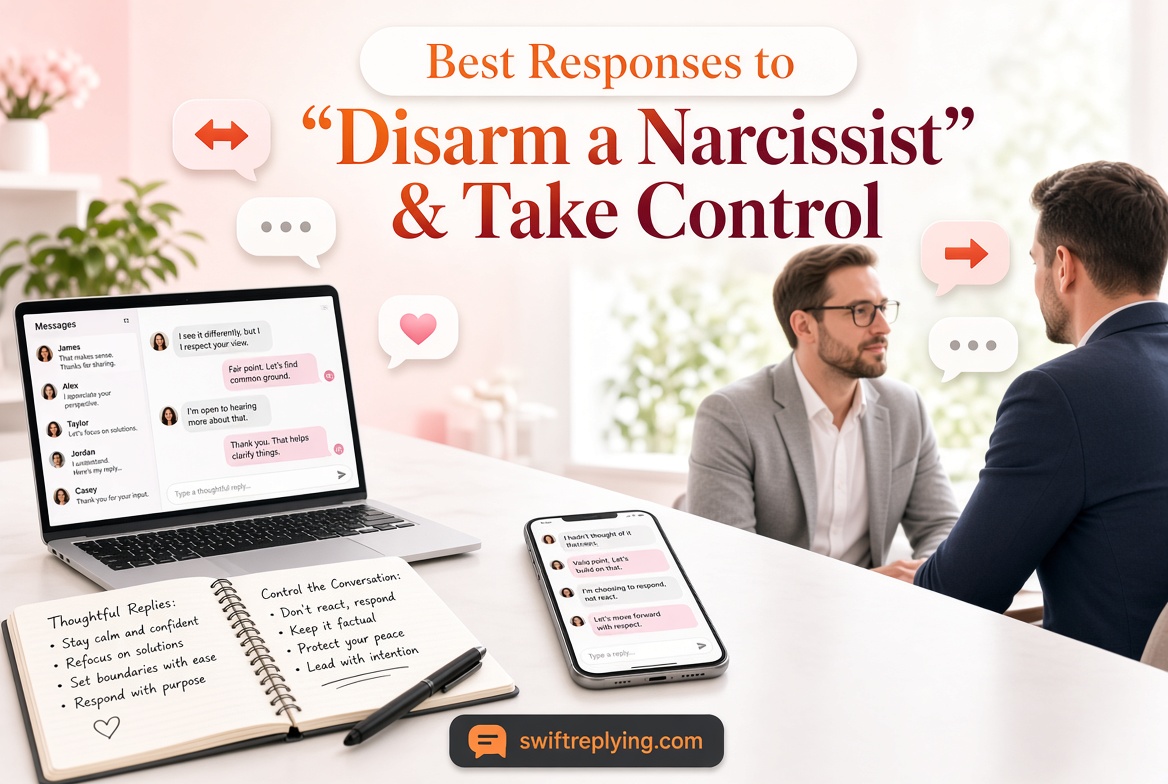
Knowing how to disarm a narcissist starts with learning to stay calm. The right words can help you take control without creating unnecessary conflict. Using simple responses and a calm voice makes difficult conversations easier.
You can set clear boundaries while continuing to protect your peace. These responses to a narcissist help you stay confident during manipulation. A short answer can prevent gaslighting, blame, and angry behavior from escalating.
Learning to refuse engagement can help you take back control of conversations. These approaches also help you protect your feelings when interactions become emotionally draining.
Quick Answer
The best way to disarm a narcissist is to stay calm, avoid long arguments, keep your answers short, and set firm boundaries. Do not give them the emotional reaction they may want. Use simple phrases that show confidence, refuse unfair blame, and bring the conversation back to facts. Your goal is not to win the argument, but to protect your peace and control your own response.
How to Use These Disarm a Narcissist Responses
Use these responses when someone tries to provoke you, shift blame, twist your words, or pressure you into an argument. Pick a sentence that matches the situation and say it calmly. You do not need to defend every choice or explain every feeling. If the conversation becomes disrespectful, repeat your boundary or end the discussion. Staying calm and consistent is often more powerful than trying to prove someone wrong.
Calm Responses to Disarm a Narcissist During Arguments
- “I understand you feel strongly, but I see the situation differently.”
- “I am willing to talk when we can both remain respectful.”
- “I will not argue about something we clearly see differently.”
- “I hear your opinion, but I do not agree with it.”
- “Let’s focus on what actually happened instead of blaming each other.”
- “I am staying calm, and I expect the same from you.”
- “We can discuss this without insults or personal attacks.”
- “I will not continue this conversation while you are shouting.”
- “Your feelings matter, but they do not decide my choices.”
- “I am not interested in turning this into another argument.”
Short Responses to Disarm a Narcissist Without Drama
- “I hear you, and I have nothing more to add.”
- “That is your view, and I respect your right to have it.”
- “I understand what you are saying, but my answer remains the same.”
- “I am not going to debate this with you.”
- “I have already answered that question clearly.”
- “There is nothing more I need to explain right now.”
- “I will think about it and respond later if needed.”
- “I am comfortable with my decision, even if you disagree.”
- “I do not want to continue discussing this.”
- “We can leave this conversation here for now.”
See Also: 200+ Best Responses to “Womp Womp”
Boundary Responses to Disarm a Narcissist
- “Please speak to me respectfully, or I will leave this conversation.”
- “I will not accept insults, threats, or personal attacks.”
- “You are free to disagree, but you cannot disrespect me.”
- “That boundary is important to me, and I will keep it.”
- “I will decide what works best for me.”
- “I am not available for this kind of conversation.”
- “If you continue shouting, I will end this discussion.”
- “My personal choices are not open for your control.”
- “I have explained my boundary, and I will not repeat it.”
- “Respect is required if we are going to keep talking.”
Responses to Disarm a Narcissist Who Blames You
- “I accept responsibility for my part, but not for everything.”
- “We both have choices, and I will not carry yours.”
- “I am willing to discuss facts instead of accepting unfair blame.”
- “Blaming me will not solve the problem we are discussing.”
- “I can own my mistake without accepting something I did not do.”
- “That accusation is not accurate, and I will not agree with it.”
- “Let’s look at what happened instead of deciding who to blame.”
- “I understand you are upset, but blaming me changes nothing.”
- “I will take responsibility for my actions, not someone else’s.”
- “We can find a solution without making one person the villain.”
Responses to Disarm a Narcissist Using Facts
- “Let’s stay with the facts and avoid assumptions about my intentions.”
- “That is not what happened, and I remember the situation differently.”
- “We can check what was actually said before making accusations.”
- “I prefer discussing facts rather than guesses about my feelings.”
- “My memory of that event is different from yours.”
- “I am not going to argue about something that can be verified.”
- “Let’s focus on what we both know happened.”
- “A different opinion does not change the facts.”
- “I will not accept a claim simply because you repeat it.”
- “We can discuss evidence instead of arguing about personal opinions.”
Responses to Disarm a Narcissist During Gaslighting
- “I trust my memory, even though you remember things differently.”
- “You may see it differently, but I know what I experienced.”
- “I will not question myself just because you disagree.”
- “My feelings are real, even if you do not understand them.”
- “I remember what happened, and I am comfortable with that.”
- “You do not get to decide what I experienced.”
- “I am not going to debate my own feelings with you.”
- “Your version is different from mine, and that is okay.”
- “I know what I heard, saw, and experienced.”
- “I will not let this conversation make me doubt myself.”
Confident Responses to Disarm a Narcissist
- “I know my worth, and I do not need your approval.”
- “I am confident in the choice I made for myself.”
- “You do not have to agree with me for me to move forward.”
- “I can respect myself without proving anything to you.”
- “Your opinion does not control how I see myself.”
- “I am comfortable saying no when something feels wrong.”
- “I trust myself enough to make my own decisions.”
- “I will not change my values just to keep you happy.”
- “I know what I need, and I am willing to protect it.”
- “Confidence means I can listen without surrendering my judgment.”
Responses to Disarm a Narcissist Who Wants Attention
- “I am not going to compete for attention or approval.”
- “You can have the spotlight; I am choosing peace instead.”
- “I do not need to respond to every dramatic statement.”
- “I am not interested in turning this into a performance.”
- “I will respond when there is something useful to discuss.”
- “I am not going to reward disrespect with more attention.”
- “You do not need to provoke me to get a response.”
- “I am choosing not to engage with this behavior.”
- “I would rather have a calm conversation than create more drama.”
- “I am stepping away because this conversation is becoming unproductive.”
Responses to Disarm a Narcissist Who Provokes You
- “I will not give you the reaction you are looking for.”
- “Trying to upset me will not change my decision.”
- “I am staying calm because I choose how I respond.”
- “I can feel angry without allowing anger to control me.”
- “Your words may be hurtful, but they do not control me.”
- “I am not taking the bait, and I am ending this discussion.”
- “Provoking me will not make me change my boundary.”
- “I am choosing peace instead of reacting to every comment.”
- “You can continue, but I will not participate in this behavior.”
- “I will respond when this conversation becomes respectful again.”
Responses to Disarm a Narcissist Who Criticizes You
- “Your criticism does not define my value as a person.”
- “I can consider useful feedback without accepting personal attacks.”
- “I hear your opinion, but I do not need to accept it.”
- “That comment is unnecessary, and I will not engage with it.”
- “You are allowed to dislike my choice, but it remains mine.”
- “I can learn from mistakes without accepting cruel comments.”
- “Constructive feedback is welcome, but insults are not.”
- “I am not going to defend myself against every criticism.”
- “Your judgment does not determine whether my decision is right.”
- “I know where I need to improve, and I am working on it.”
Responses to Disarm a Narcissist Who Plays the Victim
- “I understand you are hurt, but we still need honest communication.”
- “Your feelings matter, but they do not erase what happened.”
- “We can discuss your feelings without changing the facts.”
- “I am sorry you feel hurt, but I will not accept false blame.”
- “Being upset does not make every accusation true.”
- “I am willing to listen without accepting responsibility for everything.”
- “We both deserve space to explain our side.”
- “Your pain does not give either of us permission to disrespect.”
- “I can show empathy without agreeing with an unfair story.”
- “Let’s talk about the problem instead of deciding who is the victim.”
Responses to Disarm a Narcissist Who Demands Control
- “I respect your choice, and I expect you to respect mine.”
- “You cannot make personal decisions for me.”
- “I will listen to your advice, but the final choice is mine.”
- “My life requires my own decisions and personal responsibility.”
- “You can share your opinion without controlling my actions.”
- “I am not asking for permission to make this choice.”
- “I understand your preference, but I will choose what works.”
- “Control is not the same as care, and I need space.”
- “I am responsible for my choices, even when you disagree.”
- “You do not have authority over every part of my life.”
Responses to Disarm a Narcissist Who Gives Silent Treatment
- “I am available for a respectful conversation when you are ready.”
- “I will not chase someone who refuses to communicate.”
- “If you need space, take it, but I will continue my day.”
- “Silence will not pressure me into changing my decision.”
- “I am not going to beg for basic communication.”
- “We can talk when you are ready to communicate clearly.”
- “I respect your need for space, and I will give it.”
- “I will not turn silence into a guessing game.”
- “Healthy communication requires both people to participate.”
- “I am stepping back until we can speak openly and calmly.”
Responses to Disarm a Narcissist Who Twists Your Words
- “That is not what I said, so I will clarify once.”
- “Please respond to my actual words instead of changing their meaning.”
- “I know what I meant, and I will not argue about it.”
- “If you have a question, ask me directly instead of assuming.”
- “Changing my words does not change what I actually said.”
- “I will explain my point once, then we can move forward.”
- “That interpretation is yours, not what I intended to communicate.”
- “Please do not use my words to create a different story.”
- “I am happy to clarify, but I will not defend false meanings.”
- “Let’s use the exact words instead of assumptions about my message.”
Responses to Disarm a Narcissist Who Uses Guilt
- “I care about your feelings, but guilt will not change my choice.”
- “I can say no without feeling guilty about protecting myself.”
- “Your disappointment does not mean I have done something wrong.”
- “I understand you wanted something different, but my answer remains no.”
- “I will not make decisions based only on guilt.”
- “Caring about you does not mean ignoring my own needs.”
- “You can feel disappointed without making me responsible for it.”
- “I am allowed to choose what is healthy for me.”
- “I will listen to your feelings without accepting emotional pressure.”
- “Guilt is not a fair reason for me to change my boundary.”
Responses to Disarm a Narcissist in a Relationship
- “I want a relationship built on respect, honesty, and mutual effort.”
- “Love does not require me to accept repeated disrespect.”
- “I can care about you while still protecting my boundaries.”
- “Healthy relationships allow both people to have their own voice.”
- “I want solutions, not blame, threats, or emotional games.”
- “I will discuss relationship problems when we can speak respectfully.”
- “Your feelings matter, and so do mine.”
- “I will not sacrifice my peace just to avoid conflict.”
- “A strong relationship needs trust, respect, and honest communication.”
- “I want partnership, not control or fear.”
Responses to Disarm a Narcissist at Work
- “Let’s keep this discussion focused on the work and the facts.”
- “I am happy to discuss the task, but not personal attacks.”
- “Please send the details clearly so we can resolve this professionally.”
- “I will focus on my responsibilities and complete the agreed work.”
- “Let’s avoid personal comments and focus on the project.”
- “I am open to feedback that is specific and respectful.”
- “We can solve this without blaming one another.”
- “Please explain the concern clearly so I can address it.”
- “I would like to keep our communication professional and productive.”
- “I will follow the agreed process rather than argue about personalities.”
Responses to Disarm a Narcissist Through Emotional Detachment
- “I do not need to react to everything I hear.”
- “I can step back and choose my response carefully.”
- “Your emotions belong to you, and mine belong to me.”
- “I am not responsible for managing your every feeling.”
- “I can care without becoming emotionally pulled into the conflict.”
- “I am choosing distance from this argument so I can think clearly.”
- “I will not let this conversation decide how I feel about myself.”
- “I can listen without absorbing every negative comment.”
- “Peace is more important to me than winning this argument.”
- “I am stepping back because I want to protect my emotional energy.”
Responses to Disarm a Narcissist When They Threaten or Intimidate
- “I will not continue a conversation that includes threats or intimidation.”
- “Threats are not acceptable, and I am ending this conversation.”
- “I am taking this seriously and will protect myself appropriately.”
- “You do not get to frighten me into agreeing with you.”
- “I will not respond to threats with anger or more threats.”
- “This conversation can continue only when everyone feels safe.”
- “I am leaving this situation because the behavior is unacceptable.”
- “I will not negotiate while you are trying to intimidate me.”
- “Your threat does not give you control over my decision.”
- “My safety comes first, so I am stepping away now.”
Responses to Disarm a Narcissist and End the Conversation
- “I have said what I needed to say, so I am ending this conversation.”
- “We are going in circles, and I am choosing to stop now.”
- “This conversation is no longer helpful, so I am stepping away.”
- “I will talk again when we can communicate with respect.”
- “I am not going to repeat myself anymore.”
- “There is nothing productive left for us to discuss right now.”
- “I am ending this discussion and taking some space.”
- “We disagree, and continuing this argument will not change that.”
- “I have made my position clear, and I am moving on.”
- “I am choosing peace, so this conversation ends here.”
Responses to Disarm a Narcissist and Protect Your Peace
- “Protecting my peace is not selfish, and I will continue doing it.”
- “I choose calm conversations and healthy boundaries in my life.”
- “I do not need chaos to prove that I care.”
- “My peace matters, and I will not apologize for protecting it.”
- “I am allowed to step away from unhealthy conversations.”
- “I can respect someone without allowing them to mistreat me.”
- “I am choosing stability over arguments that never lead anywhere.”
- “My mental space deserves the same respect as yours.”
- “I will not sacrifice my well-being to keep someone else comfortable.”
- “Peace begins when I stop trying to control someone else’s behavior.”
Responses to Disarm a Narcissist and Take Control
- “I cannot control your behavior, but I can control my response.”
- “My choices belong to me, and I am taking responsibility for them.”
- “I decide what conversations I join and when I leave.”
- “You may disagree, but you cannot control my decision.”
- “I am taking back control by choosing how I respond.”
- “I will not allow pressure to make my choices for me.”
- “I know my boundaries, and I will act on them.”
- “I am no longer participating in conversations that harm my peace.”
- “I control my actions, my words, and the limits I set.”
- “I do not need to control you to take control of myself.”
FAQs
How can you disarm a narcissist and take control of conversations?
Use simple responses, stay calm, and speak in a calm voice without overexplaining. Set clear boundaries and refuse engagement when manipulation begins.
What are effective responses to a narcissist during conflict?
Try I hear you, I disagree, or That does not work for me. These short neutral phrases help you protect your peace without escalating arguments.
How should you handle gaslighting, blame, and angry behavior?
Avoid trying to explain everything, and focus on a firm boundary instead. Stay confident and limit your emotional reaction to their behavior.
How can you take back control when dealing with manipulation?
Recognize common tactics, refuse engagement, and avoid giving excessive emotional attention. Clear communication can help you protect your feelings during difficult interactions.
Can short answer responses help when arguing with a narcissist?
Yes, a short answer can reduce opportunities for starting another fight. Speaking calmly helps deescalate the argument and makes leaving the conversation easier when needed.
Conclusion
Learning to disarm a narcissist means choosing simple responses, stay calm, and set clear boundaries. The right words can help you take control without feeding gaslighting, blame, or manipulation. With a short answer, calm voice, and confidence, you can protect your peace and protect your feelings.