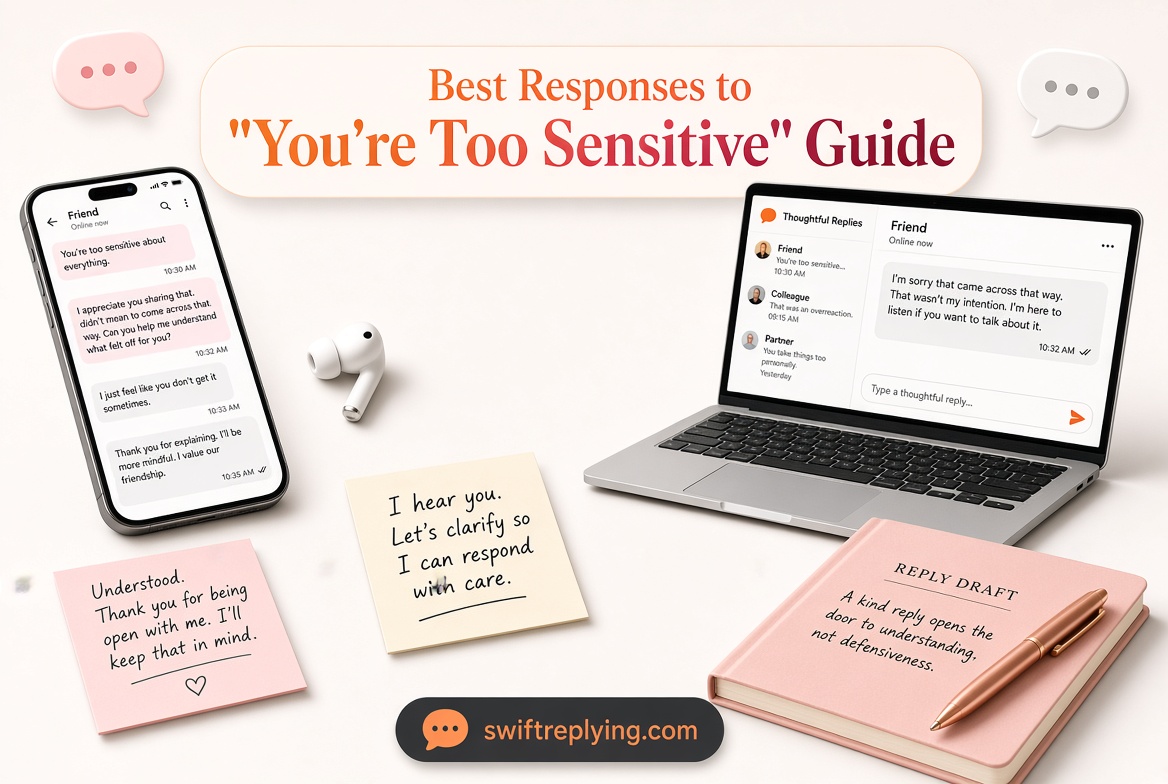
Being called you’re too sensitive can feel dismissive, especially during difficult conversations. The best responses help you stay calm while expressing yourself clearly.
A calm reply can protect your feelings without creating more conflict. You can choose a confident comeback while keeping the conversation respectful.
Instead of hiding your emotions, explain how something made you feel. A polite response can set boundaries without deflecting blame or avoiding accountability.
Being sensitive is not a personal deficiency, and your feelings matter. These responses to “you’re too sensitive” help you stand your ground respectfully.
Quick Answer
The best response to “you’re too sensitive” is one that calmly explains that your feelings are valid and deserve respect. You can say, “I understand you may see it differently, but my feelings are still real.” A good reply does not need to be rude, angry, or defensive. It simply sets a clear boundary and keeps the conversation respectful.
How to Use These “You’re Too Sensitive” Responses
Choose a response based on the person, situation, and tone of the conversation. If someone is joking, a light reply may work well. If someone keeps dismissing your feelings, use a firm and confident response. You can also stay calm and explain what hurt you instead of arguing about whether you are sensitive. The goal is not always to win the conversation. Sometimes, the best response is simply to make your feelings clear and protect your peace.
Calm Responses to “You’re Too Sensitive”
- I understand your point, but my feelings still matter to me. 🙂
- Maybe I feel things deeply, but that does not make me wrong.
- I hear what you are saying, but I see the situation differently.
- Being sensitive does not mean I cannot handle honest conversations.
- I would rather discuss the issue than argue about my feelings.
- I am calm, and I simply want you to understand my perspective.
- My reaction may differ from yours, and that is completely okay.
- I respect your opinion, but I also respect how I feel.
- I am not trying to create drama; I am explaining what hurt.
- We can disagree without making my feelings the problem.
Polite Responses to “You’re Too Sensitive”
- I appreciate your opinion, but I hope you can respect my feelings.
- Maybe we simply react to things differently, and that is okay.
- I understand you did not mean harm, but it still affected me.
- I would appreciate it if you listened before judging my reaction.
- I am sharing my feelings, not asking you to agree with them.
- Thank you for sharing your view; mine is simply different.
- I would rather have a respectful conversation about what happened.
- Your intention matters, but so does the effect of your words.
- I know you may not understand, but I hope you can respect it.
- I am trying to communicate honestly, not make you feel guilty.
Also Read This: 200+ Best Responses to “Hey Honey” That Will Make Them Smile
Confident Responses to “You’re Too Sensitive”
- I know myself well, and I am comfortable with how I feel.
- My sensitivity is part of me, and I will not apologize for it.
- I can handle difficult things without ignoring my emotions.
- Calling me sensitive does not change what actually happened.
- I am allowed to notice things that others may overlook.
- I trust my feelings enough to speak about them honestly.
- Being sensitive does not give anyone permission to disrespect me.
- I know the difference between overreacting and standing up for myself.
- My feelings are not weaknesses, and I will not treat them that way.
- I am confident enough to say when something does not feel right.
Short Responses to “You’re Too Sensitive”
- Maybe, but my feelings are still valid to me.
- I simply see things differently from you.
- My feelings deserve respect too.
- I know how I feel.
- That is your opinion, not my reality.
- I am allowed to feel this way.
- Sensitivity does not mean weakness.
- I would rather be honest than pretend.
- We do not have to agree.
- I am comfortable with my emotions.
Funny Responses to “You’re Too Sensitive”
- Maybe my feelings just come with excellent high-definition reception. 😂
- Sorry, my emotional settings are apparently stronger than yours today.
- I guess my feelings forgot to ask permission before showing up. 😄
- Maybe I need an emotional volume button for moments like this.
- Sensitive? Perhaps, but at least I notice what is happening. 😂
- My feelings may be loud, but they usually have something useful.
- I promise my emotions are not accepting customer complaints today. 😅
- Maybe I came with extra feelings included at no additional cost.
- I prefer sensitive over completely unaware, honestly.
- My emotional radar works pretty well, thank you very much. 😄
Mature Responses to “You’re Too Sensitive”
- I think maturity means being able to discuss feelings without dismissing them.
- We can talk about the problem without attacking each other.
- I am willing to hear your side if you hear mine.
- Healthy communication allows both people to express how they feel.
- I would rather understand each other than prove someone wrong.
- My goal is better communication, not an argument.
- We may remember the situation differently, and both views can matter.
- I am open to feedback, but I will not ignore my feelings.
- A mature conversation should leave room for emotions and understanding.
- Let us focus on what happened instead of labeling each other.
Strong Responses to “You’re Too Sensitive”
- You do not get to decide whether my feelings are valid.
- Calling me sensitive will not erase the impact of your words.
- I will not accept being dismissed when I explain my feelings.
- My emotions are not something you get to control.
- If something hurts me, I have every right to say so.
- I expect respect even when we disagree.
- I am not asking permission to have feelings.
- Your discomfort with my reaction does not make my feelings wrong.
- I will speak up when something crosses my boundaries.
- If you cannot respect my feelings, this conversation needs to stop.
Respectful Comebacks to “You’re Too Sensitive”
- I may be sensitive, but I am also paying attention.
- Maybe I care more deeply than you do.
- I would rather feel deeply than stop caring completely.
- Sensitivity helps me understand things you may not notice.
- You call it sensitivity; I call it emotional awareness.
- Perhaps my reaction is different because my experience is different.
- I do not think caring deeply is something to hide.
- My emotions are telling me something, so I choose to listen.
- Being sensitive has never stopped me from being strong.
- I can be sensitive and still have strong boundaries.
Responses to “You’re Too Sensitive” From Friends
- I value our friendship, so I want to be honest about this.
- I know you were joking, but the comment still bothered me.
- Friends should be able to talk about feelings without feeling judged.
- I am telling you because our friendship matters to me.
- Please understand that what seems small to you felt different to me.
- I do not want an argument; I just want you to understand.
- I hope we can talk about this without making it personal.
- I trust you enough to tell you when something hurts.
- I know you may not have meant it badly.
- I would appreciate more care when we talk about personal things.
Responses to “You’re Too Sensitive” From a Partner
- I need you to listen to my feelings instead of dismissing them.
- I am sharing this because I want us to understand each other.
- Your words affect me, and I need you to recognize that.
- We both deserve to feel heard and respected in this relationship.
- I am not blaming you; I am explaining how I felt.
- Please do not label my emotions when I am trying to communicate.
- I want us to solve the issue instead of ignoring it.
- My feelings are part of who I am, and they matter.
- I need emotional understanding, not criticism, when I open up.
- A strong relationship should have room for honest feelings.
Responses to “You’re Too Sensitive” at Work
- I understand your feedback, but I would appreciate a respectful approach.
- I am focused on the issue, not trying to take things personally.
- Please address the work concern without making comments about my personality.
- I can accept feedback while still expecting professional communication.
- I am happy to discuss the problem and find a solution.
- Let us focus on the work instead of labeling my reaction.
- I take feedback seriously, but I also value respectful communication.
- I would prefer specific feedback rather than comments about being sensitive.
- I am open to improving, so please tell me what needs changing.
- We can solve this professionally without making personal judgments.
Responses to “You’re Too Sensitive” From Family
- I know you may see things differently, but this matters to me.
- I would appreciate understanding instead of being told how to feel.
- Family should be a safe place for honest feelings.
- I am not trying to disrespect anyone by expressing myself.
- Please listen to what I am saying before judging my reaction.
- I understand your intentions, but the words still affected me.
- I would rather talk openly than keep my feelings inside.
- We can disagree while still treating each other with kindness.
- I am allowed to have feelings even when others disagree.
- I hope you can respect my emotions even if you disagree.
Responses to “You’re Too Sensitive” From a Stranger
- You do not know enough about me to judge how I feel.
- I would appreciate keeping this conversation respectful.
- You may see things differently, and that is fine.
- I am simply responding to what was said.
- I do not think this conversation needs a personal judgment.
- Let us keep the discussion focused on what actually happened.
- You are entitled to your opinion, but so am I.
- I am comfortable expressing myself without needing your approval.
- There is no need to make this personal.
- I think we can disagree without making comments about each other.
Responses When Someone Says You Are Too Emotional
- Having emotions does not mean I cannot think clearly.
- I can feel strongly and still make thoughtful decisions.
- My emotions are part of my experience, not a character flaw.
- I am allowed to care about things that matter to me.
- Being emotional does not automatically make my response unreasonable.
- I can listen to facts while still acknowledging my feelings.
- My feelings and my ability to think can exist together.
- I do not need to become emotionless to be taken seriously.
- Strong emotions can happen when something truly matters.
- I would rather understand my emotions than pretend they do not exist.
Responses When Someone Dismisses Your Feelings
- I need you to hear me instead of telling me how to feel.
- Dismissing my feelings will not make the issue disappear.
- I am asking for understanding, not permission to feel this way.
- Please listen to my concern before deciding that I am overreacting.
- My feelings may not match yours, but they are still real.
- I deserve to be heard when something affects me.
- Telling me I am sensitive avoids the real issue.
- I would like us to discuss what happened honestly.
- Please respond to what I said instead of judging my emotions.
- I am trying to communicate, so please do not shut me down.
Responses That Set Healthy Boundaries
- I will continue this conversation when we can speak respectfully.
- I am happy to talk, but I will not accept insults.
- Please respect my feelings even if you disagree with them.
- I will not stay in conversations where my emotions are mocked.
- We can discuss the issue without crossing personal boundaries.
- I am willing to listen when the conversation remains respectful.
- If you dismiss my feelings, I will step away.
- I deserve conversations where I can speak without being judged.
- Please do not use my emotions against me.
- I am setting this boundary because respectful communication matters to me.
Clever Responses to “You’re Too Sensitive”
- Maybe I am sensitive, but that helps me notice important details.
- I would rather notice feelings than ignore them completely.
- If caring is sensitivity, then I am comfortable being sensitive.
- Perhaps my emotional awareness is simply stronger than yours.
- I notice things deeply, and I do not see that as weakness.
- Sensitivity can be useful when it helps people understand each other.
- Maybe the problem is not sensitivity but how we communicate.
- I am not embarrassed by having emotions.
- I think awareness is better than pretending nothing matters.
- My feelings are information, not something I need to fear.
Kind Responses to “You’re Too Sensitive”
- I know you may not understand, but I hope you can be kind.
- I am trying to explain myself because I care about our relationship.
- Please remember that people experience the same moment differently.
- I do not expect you to feel exactly what I feel.
- I simply hope you can listen without judging me.
- We can handle this gently without making anyone feel small.
- I appreciate you listening, even if we disagree.
- I am not looking for blame; I am looking for understanding.
- Sometimes a little kindness can make difficult conversations much easier.
- I hope we can both leave this conversation feeling respected.
Responses to “Stop Being So Sensitive”
- I will manage my feelings in the way that works for me.
- I can work on my reactions without pretending I feel nothing.
- I am allowed to take time when something hurts.
- Please give me space to process what happened.
- I do not need to hide my emotions to prove strength.
- I am listening to you, but I also need to listen to myself.
- I can choose how I respond without denying what I feel.
- Being calm does not mean pretending something did not hurt.
- I will handle my feelings responsibly, but they still matter.
- I would rather respond thoughtfully than react without thinking.
Responses to “You Take Everything Personally”
- I do not take everything personally; I care about how words affect people.
- If something directly affects me, I think discussing it is reasonable.
- I can tell the difference between feedback and disrespect.
- I am not assuming everything is about me.
- I am simply responding to something that directly involved me.
- You may not have intended it personally, but it affected me.
- I can accept mistakes without ignoring their impact.
- Sometimes words matter because relationships matter.
- I am open to hearing your intention, but my reaction still matters.
- Understanding impact does not mean ignoring your original intention.
Responses That End the Conversation
- I have explained how I feel, and I do not want to argue.
- We clearly see this differently, so I am ending the conversation.
- I am not going to defend my feelings any further.
- This conversation is no longer productive, so I am stepping away.
- I have heard your opinion, and I will leave it there.
- We do not need to agree about how I feel.
- I am choosing peace instead of continuing this argument.
- I have said what I needed to say, so we can stop here.
- I will not continue a conversation that dismisses my feelings.
- Let us revisit this when we can speak calmly and respectfully.
Responses That Show Self-Respect
- I know my worth, and I will not apologize for having feelings.
- I respect myself enough to speak when something feels wrong.
- My emotions do not make me less worthy of respect.
- I can be sensitive, strong, thoughtful, and confident at once.
- I refuse to let someone else define how I should feel.
- I trust myself to understand what affects me.
- I will protect my peace without disrespecting anyone else.
- I know when something crosses a personal boundary.
- I deserve to communicate without being made to feel ashamed.
- Respecting myself means taking my feelings seriously.
Responses for Texting and Social Media
- I am not being dramatic; I am simply being honest about my feelings.
- You may disagree with my reaction, but please respect my perspective.
- I know what I felt, and I am not ashamed of it.
- Calling me sensitive does not answer what I actually said.
- I would rather communicate openly than pretend everything is fine.
- My feelings are not up for debate.
- You can disagree without dismissing what I experienced.
- I am comfortable with my emotions, so there is no issue.
- I said how I felt, and I stand by that.
- If you want to talk respectfully, I am willing to listen.
FAQs
What are the best responses to “you’re too sensitive”?
The best responses help you stay calm, express yourself clearly, and protect your feelings without creating more conflict.
How can I give a calm reply when someone calls me too sensitive?
A calm reply can explain how their hurtful words affected you while helping you keep conversation respectful.
Is being sensitive a personal deficiency?
Being sensitive is not a personal deficiency. A sensitive person can have emotional strength, self-compassion, and a strong ability to care.
How can I respond without hiding my emotions?
You can avoid hide your emotions by choosing a polite response that lets you explain how something made you feel honestly.
How can sensitive people stand their ground respectfully?
Sensitive people can practice standing your ground by setting clear boundaries, refusing to accept unfair labels, and staying respectful.
Conclusion
Handling you’re too sensitive comments starts with a calm reply and the confidence to express yourself clearly. The best responses help protect your feelings, stand your ground, and keep the conversation respectful without hiding your emotions. Remember, being sensitive is not a weakness, and showing emotional strength can help you respond with confidence and self-respect.