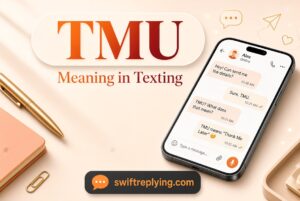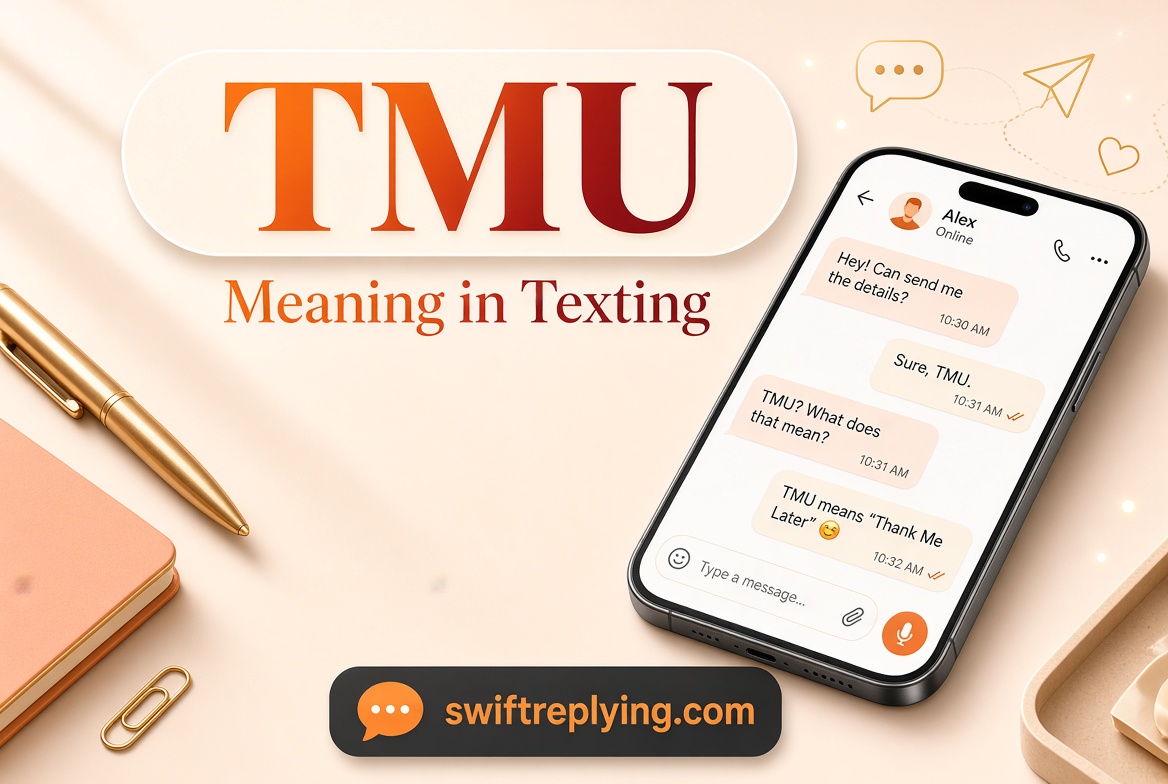
Have you received a message with “TMU” and wondered what the sender meant? Text abbreviations can make conversations confusing, especially when the same letters have different meanings. You might see TMU in a casual chat, a social media comment, or a conversation with a friend. However, its meaning depends on the words around it and the situation.
Understanding TMU meaning in texting can help you read messages correctly and respond with confidence. Some people may use it as shorthand for “text me up” or another phrase, while others may use it differently within their friend group. In this guide, you’ll learn the possible meanings of TMU, how to understand it from context, and what to say when someone sends it to you.
Quick Answer: What Does TMU Mean in Texting?
TMU doesn’t have one universally accepted meaning in texting. One possible interpretation is “text me up,” meaning the sender wants you to text them. However, the abbreviation may have a different meaning depending on the conversation, the sender’s habits, and the platform.
For example:
- “TMU when you’re free.” The sender may mean that you should text them when you have time.
- “TMU about the plans.” The sender may be asking you to message them with more information.
- “What does TMU mean?” The sender may simply be asking about the abbreviation itself.
It’s important not to assume that every person uses TMU the same way. If the surrounding message doesn’t make its meaning clear, asking the sender is the easiest way to avoid confusion.
What Does TMU Stand For?
TMU is an abbreviation made from the first letters of a phrase or name. In informal digital conversations, people often shorten words to type faster. However, not every abbreviation has one fixed definition.
When you encounter TMU, consider these possibilities.
TMU as “Text Me Up”
One possible interpretation of TMU is “text me up.” In this usage, the sender may be inviting you to send them a text message.
For example:
Person A: “I have something funny to tell you.”
Person B: “Really? TMU later!”
In this hypothetical example, Person B may be asking Person A to send a message later.
Still, “text me up” isn’t a universally established meaning of TMU. Some people may use a different abbreviation for the same idea, such as “HMU,” which commonly means “hit me up.” Therefore, the surrounding conversation matters.
TMU as a Personal or Group Abbreviation
Friends sometimes create their own shortcuts for phrases they use regularly. A group might use TMU to refer to a particular joke, plan, activity, or expression.
For instance, a group of friends could agree that TMU stands for a phrase that only they understand. Someone outside the group might not recognize it at all.
In this situation, searching for a general definition may not help. The sender’s personal meaning is more important than a dictionary-style interpretation.
TMU as an Organization or Name
TMU can also stand for Toronto Metropolitan University, a university in Toronto, Canada. This meaning is more likely in conversations about college, education, campus activities, or admissions than in casual texting.
For example:
Person A: “Where are you planning to study?”
Person B: “I’m looking at programs at TMU.”
Here, the context points to the university rather than a texting expression.
This illustrates an important point: abbreviations aren’t limited to slang. They can also represent institutions, businesses, places, and other names.
How to Understand TMU From Context
The most reliable way to interpret an unfamiliar abbreviation is to read the entire message rather than focusing on three letters.
Use the following steps when someone sends you TMU.
Read the Words Before and After TMU
Look at the sentence containing the abbreviation. The surrounding words often provide clues about the sender’s intention.
For example:
- “TMU when you get home.” This may suggest a request to send a message later.
- “I got accepted at TMU.” This likely refers to a university if the conversation concerns education.
- “What is TMU supposed to mean?” This is a direct question about the abbreviation.
Notice how each example points toward a different interpretation. The letters alone don’t provide enough information to determine the meaning with certainty.
Think About Your Relationship With the Sender
The sender’s identity can also help you understand the message.
A close friend may use personal shorthand, inside jokes, or expressions that you both recognize. A coworker might use TMU as an internal workplace abbreviation. Someone you recently met may use slang that isn’t familiar to you.
However, don’t assume that a friend, partner, or coworker must mean a particular thing. Your relationship provides context, but it doesn’t prove the sender’s intention.
Consider the Platform
The platform can provide additional clues.
| Where you see TMU | What to consider |
| Text messages | The sender may be using informal shorthand. |
| Instagram comments | It could be slang, a personal abbreviation, or part of a conversation. |
| Snapchat chats | It may be a quick abbreviation understood by the people chatting. |
| Gaming chats | It could refer to a game-related term or an expression used by the group. |
| College discussions | TMU may refer to Toronto Metropolitan University. |
| Workplace messages | It could be an internal abbreviation that depends on the team. |
These are contextual possibilities, not guaranteed definitions. A platform alone cannot establish what the sender intended.
Ask for Clarification When Necessary
If you still don’t understand, ask a short and friendly question.
You could say:
- “What does TMU mean here?”
- “Wait, what do you mean by TMU?”
- “Can you explain that abbreviation?”
- “I’m not familiar with TMU. What does it stand for?”
There’s no need to feel embarrassed about asking. People use different expressions, and not everyone knows every texting abbreviation.
See Also: WYLL Meaning in Text Message: What It Means and How to Reply
Examples of TMU in Text Messages
Examples make it easier to see how an abbreviation can change meaning with context. The following are hypothetical conversations that demonstrate possible uses rather than established definitions.
Example 1: Asking Someone to Send a Message
Alex: “I’ll be busy this afternoon.”
Jordan: “Okay, TMU when you’re free.”
Possible meaning: Jordan may be asking Alex to text later.
The phrase “when you’re free” suggests that Jordan wants to continue the conversation at another time. Still, if Jordan doesn’t usually use TMU this way, asking for clarification is sensible.
Example 2: Discussing College
Alex: “Which university are you considering?”
Jordan: “TMU is one of my options.”
Likely meaning: Toronto Metropolitan University, assuming the conversation is about schools in Toronto or university applications.
Here, the educational context makes the interpretation much clearer.
Example 3: Talking About Weekend Plans
Alex: “We need to decide where we’re meeting.”
Jordan: “TMU later about it.”
Possible meaning: Jordan may be asking Alex to send a message later.
The phrase suggests future communication, but the abbreviation itself remains ambiguous. A clearer message would be “Text me later about it.”
Example 4: Using an Inside Joke
Alex: “Don’t forget our TMU rule!”
Jordan: “Haha, I remember.”
Possible meaning: TMU may refer to a private phrase or joke shared by these two people.
Without knowing their history, an outside reader cannot reliably identify the intended meaning.
Example 5: Asking About the Abbreviation
Alex: “Someone just sent me TMU.”
Jordan: “Did they explain what they meant?”
Alex: “No, that’s why I’m asking.”
In this case, the letters are the subject of the conversation rather than an abbreviation being used to communicate another message.
These examples show why it is better to interpret TMU in context than to memorize a single definition.
Is TMU a Common Texting Abbreviation?
TMU is not as widely recognizable as abbreviations such as LOL, BRB, or HMU. Its meaning may vary from one person or online community to another.
Some texting abbreviations have widely understood meanings:
| Abbreviation | Common meaning |
| LOL | Laughing out loud |
| BRB | Be right back |
| HMU | Hit me up |
| IDK | I don’t know |
| BTW | By the way |
| TTYL | Talk to you later |
| TBH | To be honest |
| IMO | In my opinion |
These are established examples of common digital shorthand. TMU is less straightforward, so you should be more cautious about assigning it a meaning.
For example, HMU is commonly used to invite someone to contact you. Although “text me up” may seem similar, you shouldn’t automatically assume TMU and HMU are interchangeable. Their meanings and usage can differ.
If someone repeatedly uses TMU in your conversations, you may learn what they mean from the way they use it. Until then, treat the abbreviation as uncertain.
What Is the Difference Between TMU and HMU?
TMU and HMU can look similar because both may appear in conversations about contacting someone. However, HMU has a widely recognized meaning, while TMU is more ambiguous.
HMU stands for “hit me up.” People commonly use it to invite someone to contact them, whether by text, phone, or another communication method.
TMU may be intended to mean “text me up” in some conversations, but that interpretation is less universally established.
Consider these examples:
HMU example:
“HMU if you want to hang out this weekend.”
This usually means that the sender wants you to contact them if you’re interested.
Possible TMU example:
“TMU when you finish work.”
The sender may mean that you should send them a text after work.
The practical difference is that HMU has a clearer, more widely recognized meaning. If you want to communicate that you would like someone to text you, writing “Text me when you’re free” is even clearer.
How Should You Reply When Someone Sends TMU?
Your response should depend on what the sender appears to mean. If you understand the message, answer naturally. If you don’t, ask what the abbreviation means.
Here are several useful responses for different situations.
When You Think They Want You to Text Later
If the message seems to be an invitation to continue the conversation, you could reply:
- “Sure, I’ll text you later.”
- “Okay, I’ll message you when I’m free.”
- “Sounds good. Talk to you soon.”
- “No problem, I’ll get back to you.”
- “Sure! I’ll reach out after work.”
These responses work when the context suggests that the sender wants to hear from you later.
When You’re Not Sure What TMU Means
If the abbreviation is unclear, you don’t need to guess. Try one of these replies:
- “What does TMU mean?”
- “Sorry, I’m not familiar with that abbreviation.”
- “Can you explain what you mean?”
- “I’m confused. What does TMU stand for?”
- “Do you mean you want me to text you?”
These replies are direct without sounding rude.
When a Friend Uses It Casually
If a friend sends TMU during a relaxed conversation, you can keep your response friendly:
- “Wait, explain that one to me!”
- “What does that mean? 😂”
- “I’m missing something here.”
- “Is that your new abbreviation?”
- “You’ll have to translate that for me!”
Choose a response that fits your usual sense of humor and the way you talk to that person.
When TMU Appears in a Work Message
If a coworker uses TMU and you aren’t sure what it means, ask politely instead of making assumptions.
For example:
“Could you clarify what TMU means in this message?”
This keeps the conversation professional and helps prevent misunderstandings. If the abbreviation refers to a team-specific process or organization, your coworker can explain it.
Can TMU Have a Flirty Meaning?
TMU does not have one established romantic or flirty meaning that applies to every conversation. However, the surrounding message may suggest that someone is interested in continuing a conversation with you.
For example, imagine someone writes:
“TMU later 😉”
If the sender has been flirting with you, they may be inviting you to message them later. The wink and the previous conversation may add a playful tone.
Still, the abbreviation alone doesn’t prove romantic interest. The sender could simply want to talk, share information, or continue an ordinary conversation.
Look at the broader pattern instead:
- Do they regularly start conversations with you?
- Do they ask questions and show interest in your answers?
- Do they use playful language that fits your relationship?
- Do they make an effort to continue talking?
These details can help you understand the conversation, but none of them guarantees that someone has romantic feelings.
If you want to respond playfully without assuming too much, try:
- “What am I supposed to text you about? 😉”
- “Sure, what time?”
- “Okay, I’ll message you later.”
- “First, tell me what TMU means!”
- “You’re going to have to explain that one.”
The best response is one that matches your comfort level and the tone of the conversation.
Is TMU Rude, Negative, or Offensive?
TMU is not inherently rude or offensive. The letters alone don’t establish whether a message is friendly, serious, or negative.
Its tone depends on the phrase the sender intends, the surrounding words, and your relationship with them.
For example, “TMU when you get home” may be a simple request to continue talking. However, if the sender uses an unfamiliar abbreviation in an argument, you may need more context to understand what they mean.
When deciding whether a message sounds rude, consider:
- The complete sentence rather than the abbreviation alone.
- Whether the sender usually communicates casually or formally.
- The tone of the conversation before the message.
- Any explanation the sender provides afterward.
If the message feels confusing or uncomfortable, ask the sender to explain it. Avoid assuming hostility based only on unfamiliar letters.
Why Do People Use Abbreviations Like TMU in Texting?
People use abbreviations because they can make informal communication quicker and more convenient. Instead of typing a full phrase, someone may use a short form that they expect the other person to understand.
Several reasons explain why texting abbreviations remain popular.
To Type More Quickly
Short forms can reduce typing, particularly during fast conversations. Friends who chat regularly may develop shortcuts for expressions they use often.
However, saving a few seconds isn’t always worth the confusion. If an abbreviation is unfamiliar, a full sentence may communicate the message more effectively.
To Match a Casual Tone
Abbreviations can make a conversation feel relaxed. Friends and family members often use informal language because they don’t need every message to sound formal.
That doesn’t mean every abbreviation is suitable for every situation. In professional communication, clear wording is usually better than unexplained shorthand.
To Follow Group Habits
People often adopt language from their friends, online communities, or social circles. An abbreviation may become familiar within a group even when people outside it don’t recognize it.
This is one reason a term can have a specific meaning in one conversation but a different meaning elsewhere.
To Express Familiarity
Shared abbreviations can reflect common experiences or inside jokes. When both people understand the same shorthand, it can make conversations feel more personal.
On the other hand, unfamiliar abbreviations can leave the recipient confused. If your goal is clear communication, use shorthand only when you have good reason to believe the other person will understand it.
Common Mistakes to Avoid When Interpreting TMU
When you receive an unfamiliar abbreviation, a few simple habits can help you avoid misunderstandings.
Assuming It Has Only One Meaning
The biggest mistake is believing that TMU always stands for the same phrase. Abbreviations can vary across communities, and some are used informally without a standard definition.
Instead, consider the entire conversation and ask for clarification when necessary.
Confusing TMU With HMU
HMU commonly means “hit me up.” TMU may be intended as “text me up” in some contexts, but you shouldn’t treat the two abbreviations as having identical, universally accepted meanings.
If you need to invite someone to contact you, “HMU” or “Text me later” is generally easier to understand.
Assuming a Romantic Meaning
A short message doesn’t automatically indicate flirting. Someone may want to continue a conversation for ordinary reasons.
Before deciding that a message is romantic, consider the sender’s overall behavior and the context of the conversation.
Overthinking a Simple Message
Sometimes, an unfamiliar abbreviation is simply a shortcut or a personal expression. You don’t need to spend a long time trying to decode it.
If you can’t understand the message from context, asking a quick question is usually the most practical solution.
Using TMU Without Explaining It
If you use TMU yourself, remember that other people may not know what you mean. This is especially important when texting someone you don’t know well.
Instead of writing an unclear abbreviation, say exactly what you want. For example, “Text me when you’re free” is more direct than an abbreviation that the recipient may not recognize.
FAQs About TMU Meaning in Texting
What does TMU mean in a text message?
TMU has no single universally accepted meaning in texting. It may be intended to mean “text me up” in some conversations, but the surrounding words and the sender’s habits determine the most likely interpretation.
Does TMU mean “text me up”?
It can be used that way by some people, especially when a message asks someone to get in touch later. However, this is not a guaranteed or universally recognized definition. Ask the sender if the meaning isn’t clear.
Is TMU the same as HMU?
No, not necessarily. HMU commonly means “hit me up,” an invitation to contact someone. TMU is more ambiguous, even if a sender intends it to mean “text me up.”
What does TMU mean on social media?
On social media, TMU may be slang, a personal abbreviation, or a reference to something discussed in the post or conversation. You need the surrounding context to determine what the person means.
How do I respond when someone texts TMU?
If you think they want you to message them later, you can reply, “Sure, I’ll text you later.” If you’re unsure, ask, “What does TMU mean?” This is the simplest way to avoid misunderstanding.
Conclusion
Understanding TMU meaning in texting starts with recognizing that abbreviations don’t always have one fixed definition. TMU may mean “text me up” in some conversations, but it can also refer to a personal expression, a group-specific term, or an organization such as Toronto Metropolitan University. Read the surrounding message, consider the context, and avoid assuming a meaning without enough information. If you’re still unsure, simply ask the sender what they mean. A quick question can keep your conversation clear, friendly, and free from unnecessary confusion.